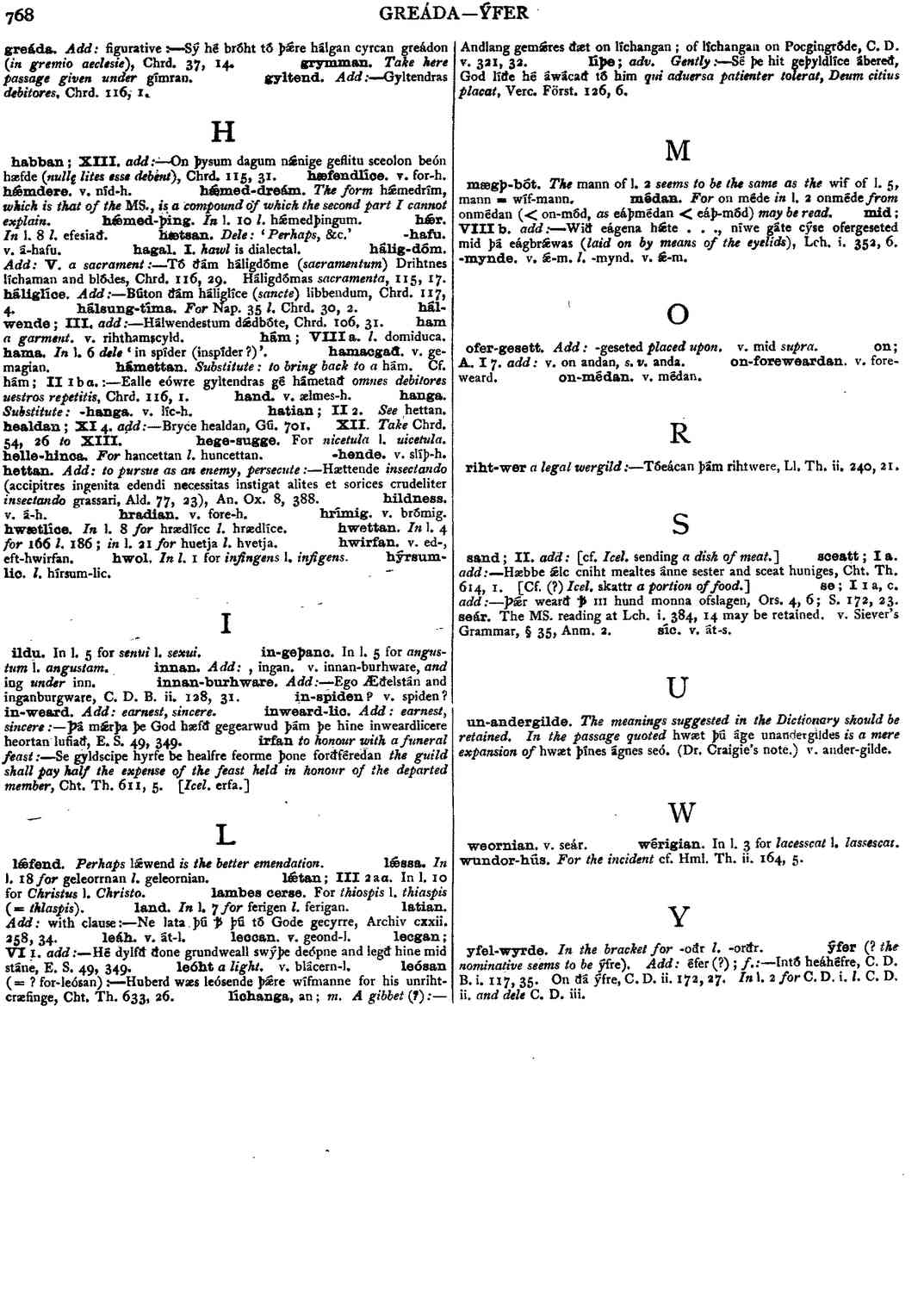
Cite the scanned version of the original dicionary like this:
Toller, T. Northcote, and Joseph Bosworth. "hám." An Anglo-Saxon Dictionary: Based on the Manuscript Collections of the Late Joseph Bosworth : Supplement. Oxford: Clarendon Press, 1921. 768.
, hom, hamm, e; f. The ham, the inner or hind part of the knee :-- Hamm poples, hamma suffragines, Ælfc. Gl. 75; Som. 71, 84, 83; Wrt. Voc. 44, 66, 65. Ham poples, 71, 50. Monegum men gescrincaþ his fét tó his homme ... gebeðe ða hamma with many a man the feet shrink up to the ham ... warm the hams, L. M. 1, 26; Lchdm. ii. 68, 3-5. [A. R. mid hommen iuolden with bent knees: Icel. höm the ham or haunch of a horse: O. H. Ger. hamma poples, suffrago.]
, hom; gen. hammes; m. A dwelling, fold, or enclosed possession. 'It is so frequently coupled with words implying the presence of water as to render it probable that, like the Friesic hemmen, it denotes a piece of land surrounded with paling, wicker-work, etc., and so defended against the stream, which would otherwise wash it away.' Cod. Dipl. Kmbl. iii. xxvii, where see instances of the occurrence of the word in local names.
, es; m. 'The Latin word which appears most nearly to translate it is vicus, and it seems to be identical in form with the Greek κώμη. In this sense it is the general assemblage of the dwellings in each particular district, to which the arable land and pasture of the community were appurtenant, the home of all the settlers in a separate and well defined locality, the collection of the houses of the freemen. Whenever we can assure ourselves that the vowel is long, we may be certain that the name implies such a village or community,' Cod. Dipl.