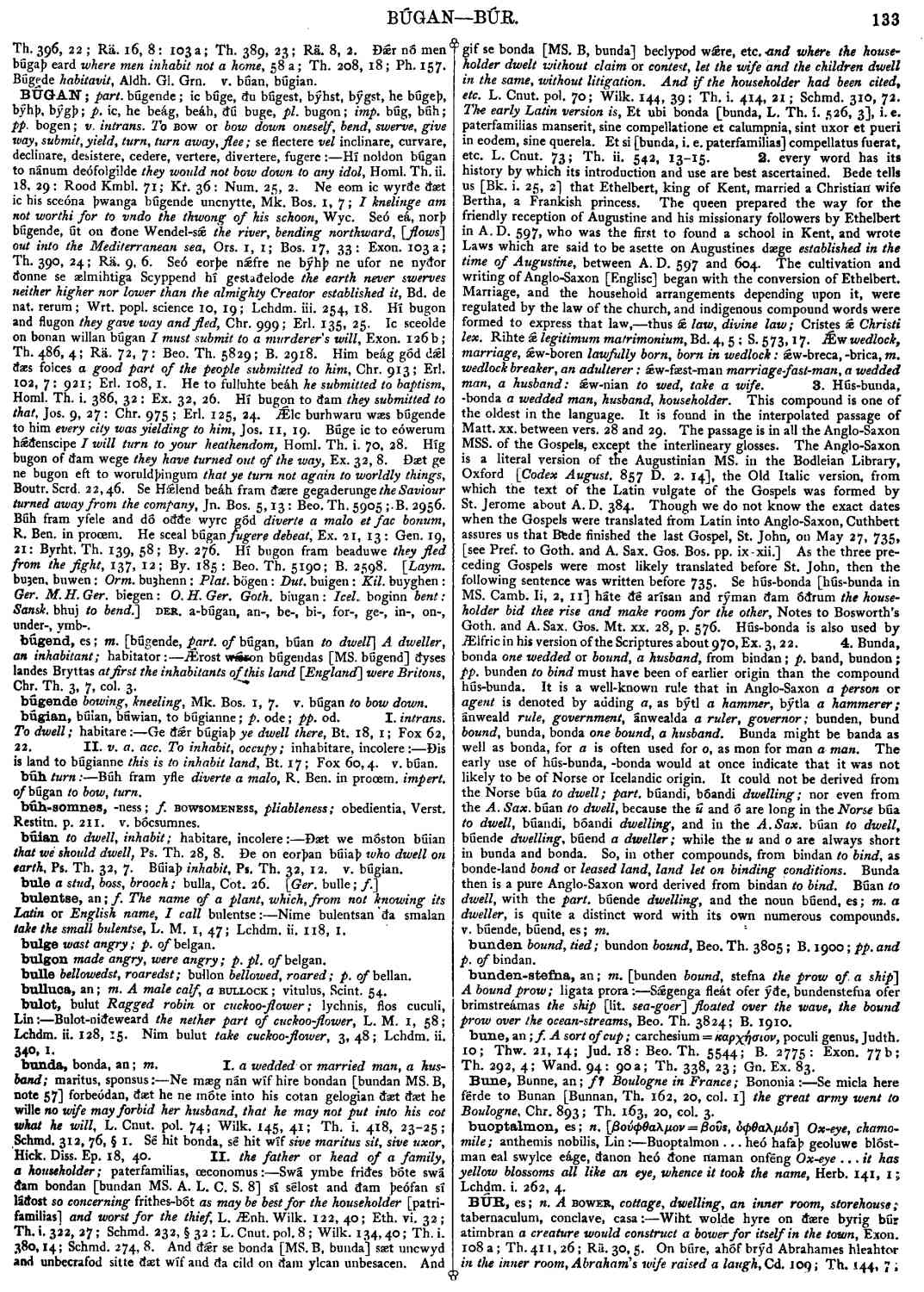
bunda
- noun [ masculine ]
-
Ne mæg nán wíf hire bondan [bundan
- MS. B, note 57
no wife may forbid her husband, that he may not put into his cot what he will,
- L. Cnut. pol. 74 ;
- Wilk. 145, 41 ;
- Th. i. 418, 23-25 ;
- Schmd. 312, 76, § I .
Sé hit bonda, sé hit wíf
sive maritus sit, sive uxor,
- Hick. Diss. Ep. 18, 40 .
-
Swá ymbe friðes bóte swá ðam bondan [bundan
- MS. A. L. C. S. 8]
as may be best for the householder [patrifamilias] and worst for the thief,
- L. Ænh. Wilk. 122, 40 ;
- Eth. vi. 32 ;
- Th. i. 322, 27 ;
- Schmd. 232, § 32 :
- L. Cnut. pol. 8 ;
- Wilk. 134, 40 ;
- Th. i. 380, 14 ;
- Schmd. 274, 8 .
-
And ðǽr se bonda [MS. B, bunda] sæt uncwyd and unbecrafod sitte ðæt wif and ða cild on ðam ylcan unbesacen. And gif se bonda [MS. B, bunda] beclypod wǽre, etc.
and where the householder dwelt without claim or contest, let the wife and the children dwell in the same, without litigation. And if the householder had been cited, etc.
- L. Cnut. pol. 70 ;
- Wilk. 144, 39 ;
- Th. i. 414, 21 ;
- Schmd. 310, 72 .
The early Latin version is, Et ubi bonda [bunda,
- L. Th. i. 526, 3
- L. Cnut. 73 ;
- Th. ii. 542, 13-15 .
- Bk. i. 25, 2
- Bd. 4, 5 ;
- S. 573, 17 .
- Matt. xx. between vers. 28 and 29.
- Codex August. 857 D. 2. 14
- Pref. to Goth. and A. Sax. Gos. Bos. pp. ix-xii.
- MS. Camb. Ii, 2, 11
- Notes to Bosworth's Goth. and A. Sax. Gos. Mt. xx. 28, p. 576.
- 970, Ex. 3, 22.
Bosworth, Joseph. “bunda.” In An Anglo-Saxon Dictionary Online, edited by Thomas Northcote Toller, Christ Sean, and Ondřej Tichy. Prague: Faculty of Arts, Charles University, 2014. https://bosworthtoller.com/5391.
Checked: 2