stóc
- noun [ neuter ]
Grammar
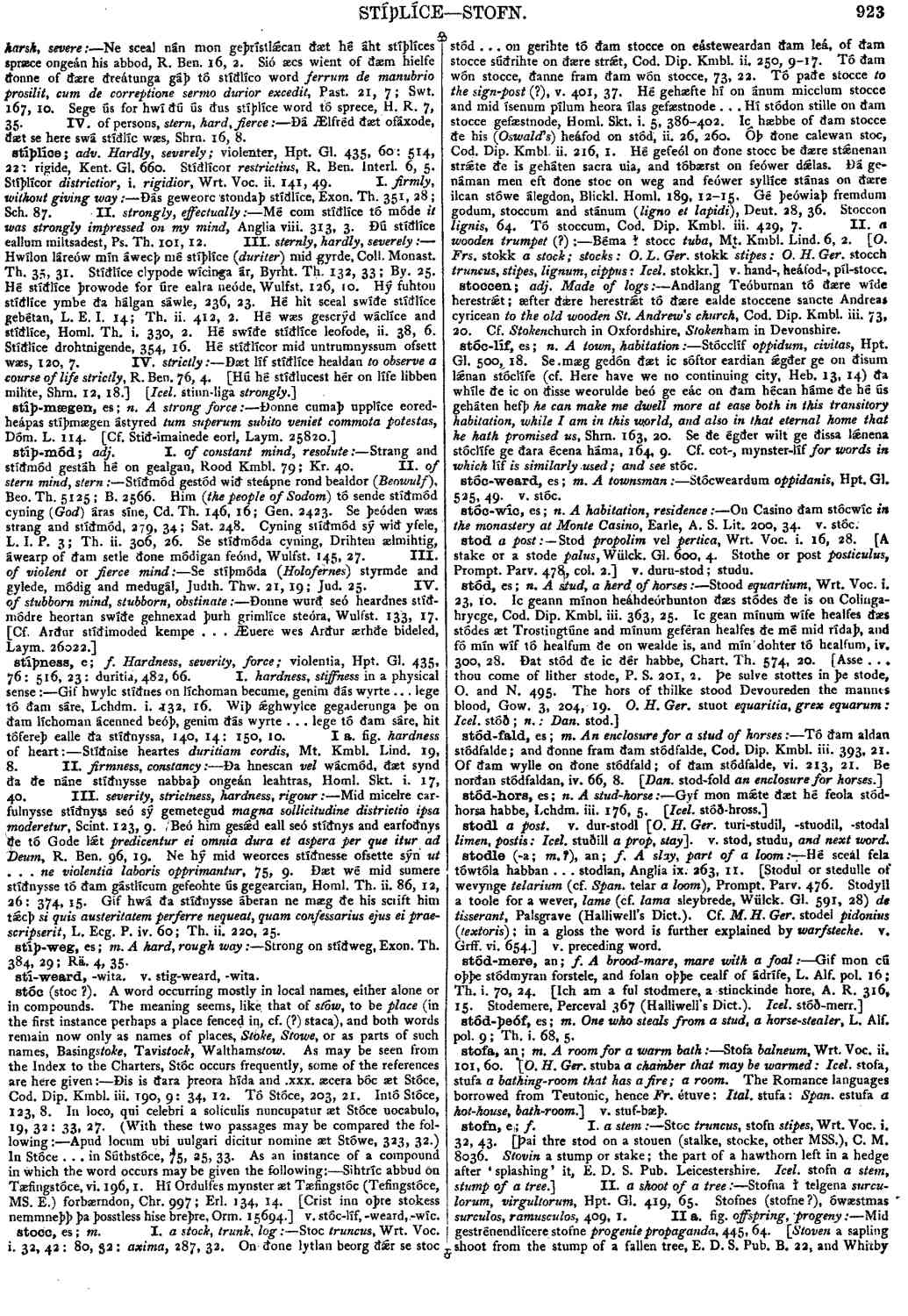
A word occurring mostly in local names, either alone or in compounds. The meaning seems, like that of stów, to be place
(in the first instance perhaps a place fenced in, cf. (?) staca), and both words remain now only as names of places,
Stoke, Stowe, or as parts of such names, Basingstoke, Tavistock, Walthamstow. As may be seen from the Index to the Charters,
Stóc occurs frequently, some of the references are here given
-
Ðis is ðara þreora hída and .xxx. æcera bóc æt Stóce,
- Cod. Dip. Kmbl. iii. 190, 9 :
- 34, 12 .
-
Tó Stóce,
- 203, 21 .
-
Intó Stóce,
- 123, 8 .
-
In loco, qui celebri a soliculis nuncupatur æt Stóce uocabulo,
- 19, 32 :
- 33, 27 .
(With these two passages may be compared the following)
(Apud locum ubi uulgari dicitur nomine æt Stówe,)
- (
- 323, 32 .)
In Stóce . . . in Súthstóce,
- 75, 25, 33 .
As an instance of a compound in which the word occurs may be given the following
Sihtríc abbud on Tæfingstóce,
- vi. 196, 1 .
-
Hí Ordulfes mynster æt Tæfingstóc (Tefingstóce, MS. E.) forbærndon,
- Chr. 997 ;
- Erl. 134, 14 .
Etymology
Crist inn oþre stokess nemmneþþ þa þosstless hise breþre, Orm. 15694.
]
Linked entries
v.
stóc-líf stóc-weard stóc-wíc.
Entry information
Citation
Bosworth, Joseph. “stóc.” In An Anglo-Saxon Dictionary Online, edited by Thomas Northcote Toller, Christ Sean, and Ondřej Tichy. Prague: Faculty of Arts, Charles University, 2014. https://bosworthtoller.com/29052.
Checked: 2