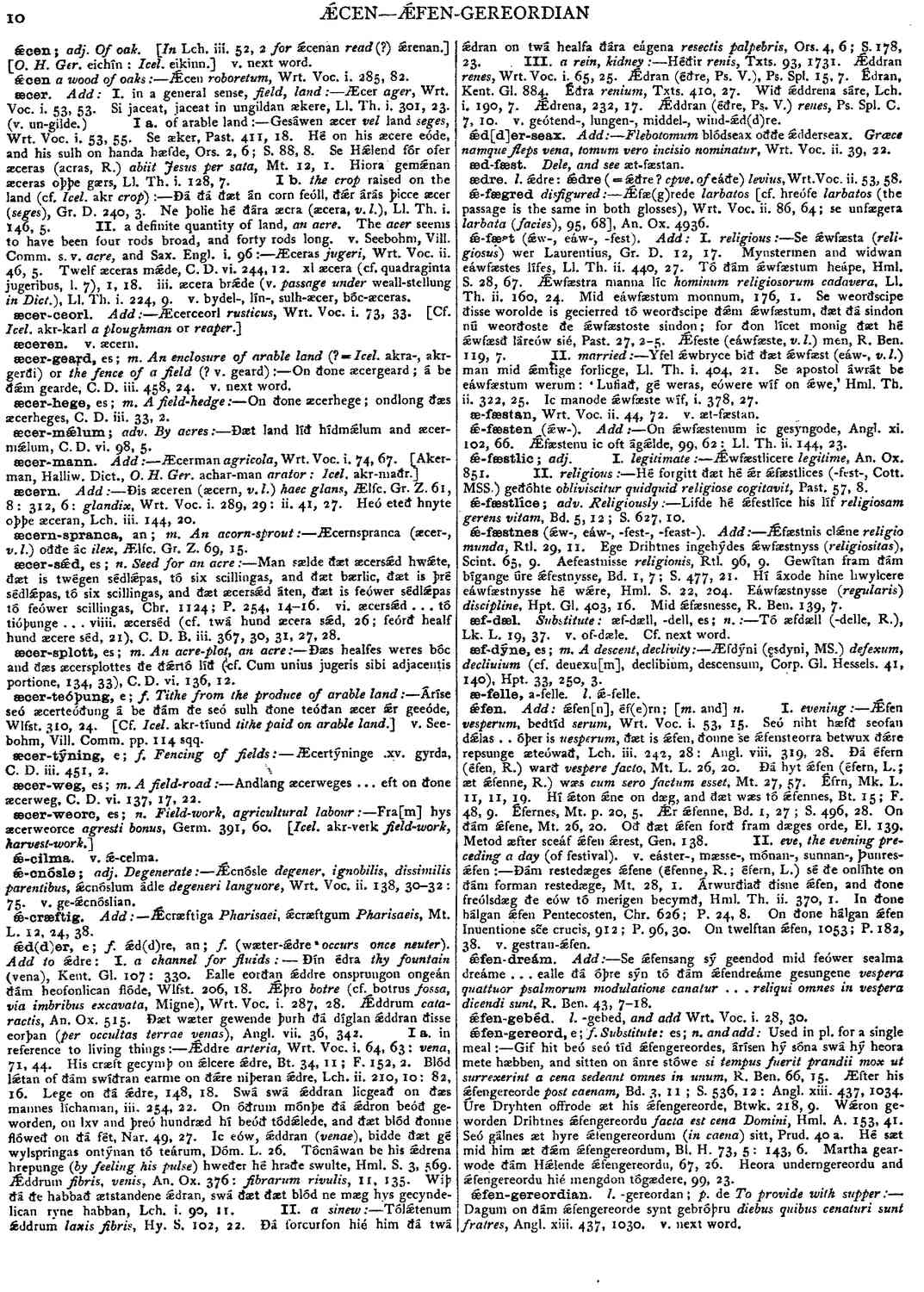
ǽder
- noun [ feminine ]
-
Ðín édra
thy fountain
(vena),
- Kent. Gl. 107: 330 .
-
Ealle eorðan ǽddre onsprungon ongeán ðám heofonlican flóde,
- Wlfst. 206, 18 .
-
Ǽþro
botre (cf. botrus fossa, via imbribus excavata, Migne),
- Wrt. Voc. i. 287, 28 .
-
Ǽddrum
cataractis,
- An. Ox. 515 .
-
Ðæt wæter gewende þurh ðá díglan ǽddran ðisse eorþan
(per occultas terrae venas),
- Angl. vii. 36, 342 .
Ǽddre
arteria,
- Wrt. Voc. i. 64, 63 :
vena,
- 71, 44 .
-
His cræft gecymþ on ǽlcere ǽdre,
- Bt. 34, 11 ;
- F. 152, 2 .
-
Blód lǽtan of ðám swíðran earme on ðǽre niþeran ǽdre,
- Lch. ii. 210, 10 :
- 82, 16 .
-
Lege on ðá ǽdre,
- 148, 18 .
-
Swá swá ǽddran licgeað on ðæs mannes líchaman,
- iii. 254, 22 .
-
On óðrum mónþe ðá ǽdron beóð geworden, on lxv and þreó hundræd hí beóð tódǽlede, and ðæt blód ðonne flóweð on ðá fét,
- Nar. 49, 27 .
-
Ic eów, ǽddran
venae
bidde ðæt gé wylspringas ontýnan tó teárum,
- Dóm. L. 26 .
-
Tócnáwan be his ǽdrena hrepunge
by feeling his pulse
hweðer hé hraðe swulte,
- Hml. S. 3, 569 .
-
Ǽddrum
fibris, venis,
- An. Ox. 376 :
fibrarum rivulis,
- 11, 135 .
-
Wiþ ðá ðe habbað ætstandene ǽdran, swá ðæt ðæt blód ne mæg hys gecyndelican ryne habban,
- Lch. i. 90, 11 .
-
Tólǽtenum ǽddrum
laxis fibris,
- Hy. S. 102, 22 .
-
Ðá forcurfon hié him ðá twá ǽdran on twá healfa ðára eágena
resectis palpebris,
- Ors. 4, 6 ;
- S. 178, 23 .
-
Héðir
renis,
- Txts. 93, 1731 .
-
Ǽddran
renes,
- Wrt. Voc. i. 65, 25 .
-
Ǽdran (éðre, Ps. V.)
- Ps. Spl. 15, 7 .
-
Édran,
- Kent. Gl. 884 .
-
Éðra
renium,
- Txts. 410, 27 .
-
Wið ǽddrena sáre,
- Lch. i. 190, 7 .
-
Ǽdrena,
- 232, 17 .
-
Ǽddran (éðre, Ps. V.)
reues,
- Ps. Spl. C. 7, 10 .
Bosworth, Joseph. “ǽder.” In An Anglo-Saxon Dictionary Online, edited by Thomas Northcote Toller, Christ Sean, and Ondřej Tichy. Prague: Faculty of Arts, Charles University, 2014. https://bosworthtoller.com/37593.
Checked: 1