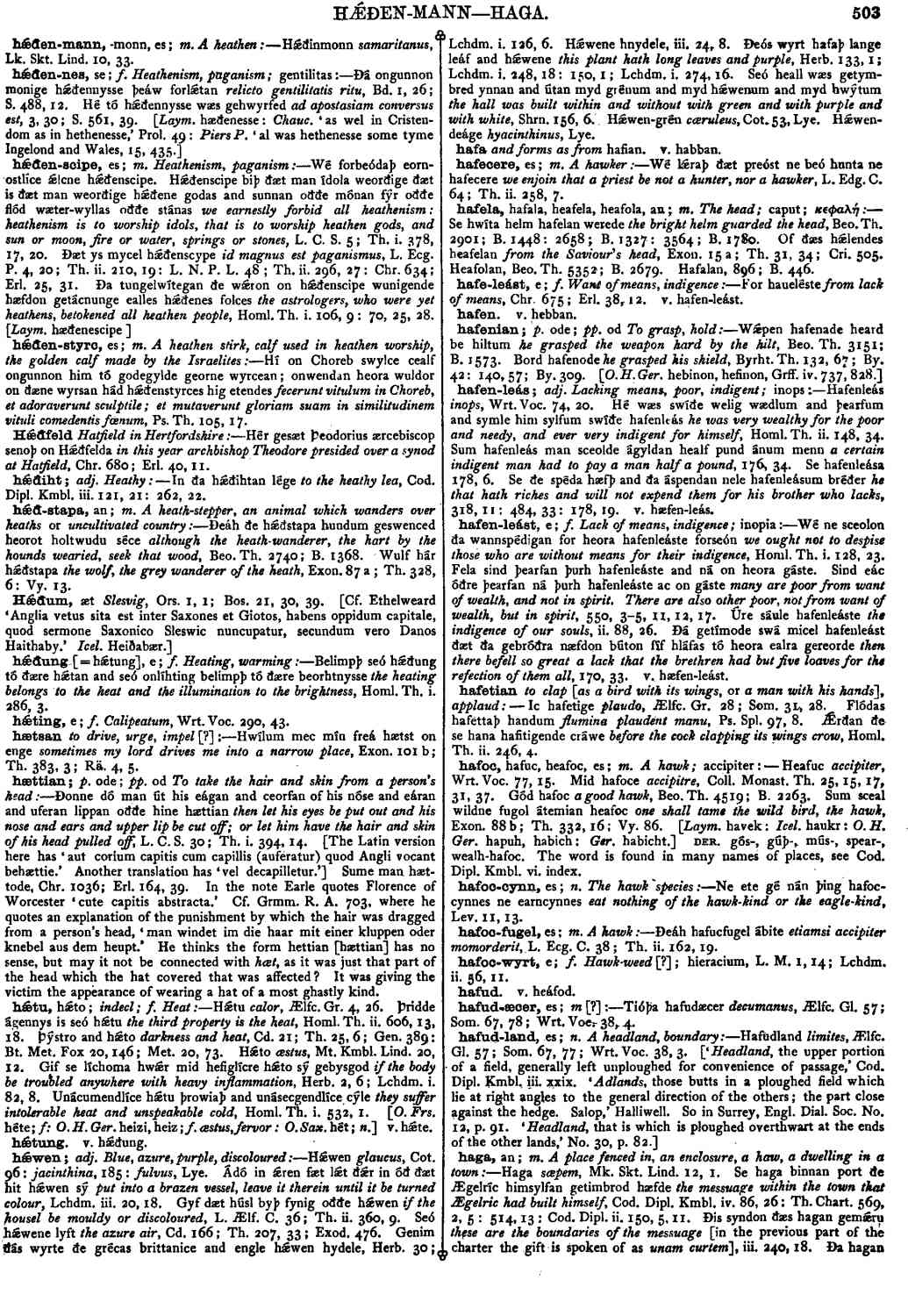
haga
- noun [ masculine ]
-
Haga
sæpem,
- Mk. Skt. Lind. 12, 1 .
-
Se haga binnan port ðe Ægelríc himsylfan getimbrod hæfde
the messuage within the town that Ægelric had built himself,
- Cod. Dipl. Kmbl. iv. 86, 26 :
- Th. Chart. 569, 2, 5 : 514, 13 :
- Cod. Dipl. ii. 150, 5, 11 .
-
Ðis syndon ðæs hagan gemǽru
those are the boundaries of the messuage [in the previous part of the charter the gift is spoken of as unam curtem ],
- iii. 240, 18 .
-
Ða haganealle ðe hé be westan cyrcan hæfde
all the messuages that he had west of the church,
- Th. Chart. 303, 10 .
-
Ǽnne hagan on porte
curtem unum in supradicta civitate,
- Cod. Dipl. Kmbl. iv. 72, 27 :
- iii. 213, 13 .
-
Quandam hospicii portionem in præfata civitate sitam, quÆ patria lingua haga solet appellari,
- vi. 134, 24 ; cf.
- 135, 14, 25 .
-
Tó hagan þrungon
they pressed to the entrenchment,
- Beo. Th. 5913 ;
- B. 2960 :
- Beo. Th. 5777 ;
- B. 2892 .
Bosworth, Joseph. “haga.” In An Anglo-Saxon Dictionary Online, edited by Thomas Northcote Toller, Christ Sean, and Ondřej Tichy. Prague: Faculty of Arts, Charles University, 2014. https://bosworthtoller.com/18013.
Checked: 1