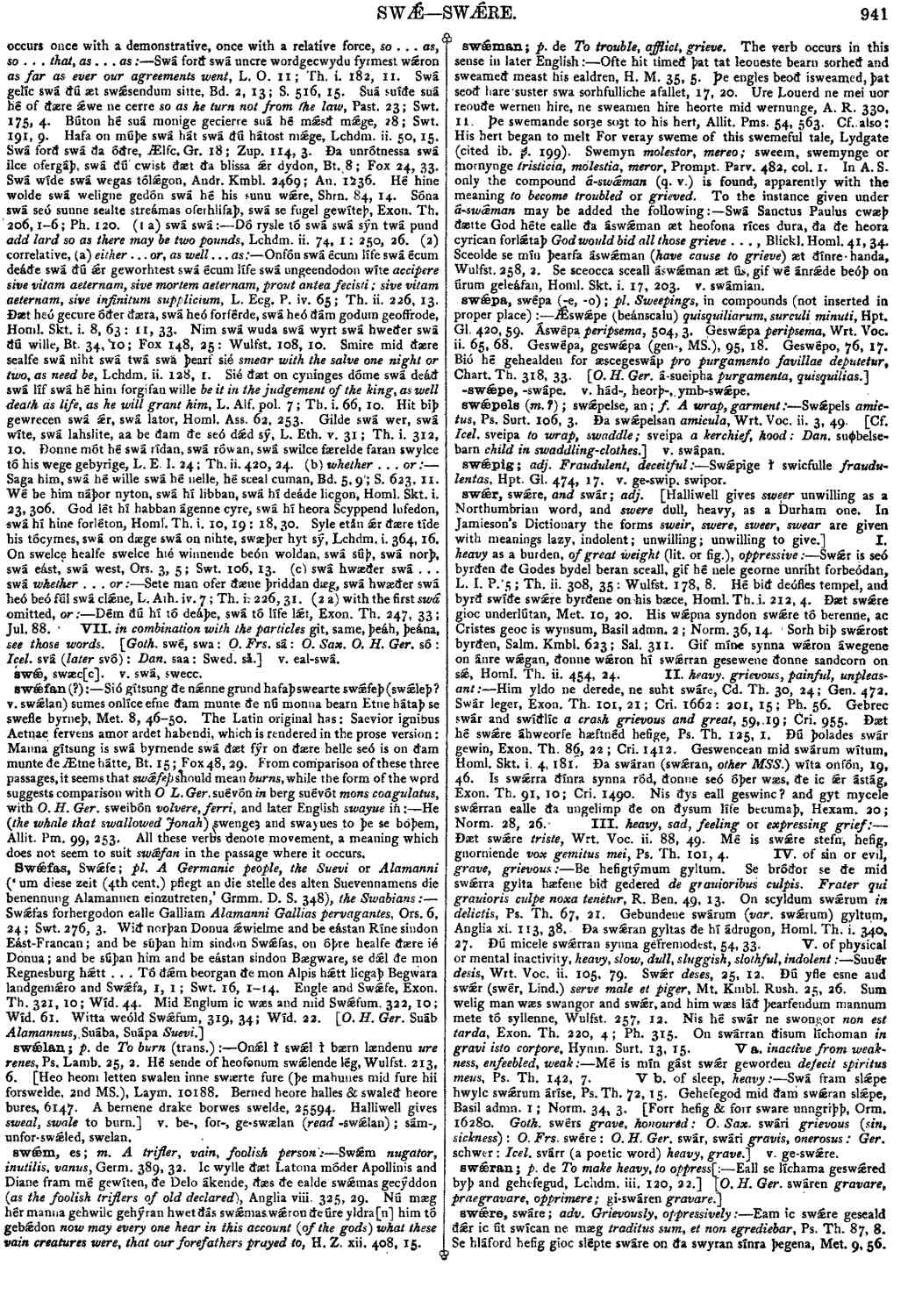
swǽman
- verb [ weak ]
-
Ofte hit timeð þat tat leoueste bearn sorheð and sweameð meast his ealdren,
- H. M. 35, 5.
-
Þe engles beoð isweamed, þat seoð hare suster swa sorhfulliche afallet,
- 17, 20.
-
Ure Louerd ne mei uor reouðe wernen hire, ne sweamen hire heorte mid wernunge,
- A. R. 330, 11.
-
Þe swemande sorȝe soȝt to his hert,
- Allit. Pms. 54, 563.
- Cf. also:
His hert began to melt For veray sweme of this swemeful tale,
- Lydgate (cited ib. p. 199)
tristicia, molestia, meror
,- Prompt. Parv. 482, col. 1.
-
In A. S. only
the compound á-swǽman (q. v.) is found, apparently with the meaning to
become troubled or grieved. To the instance given under á-swǽman may be added the
following :--
Swá Sanctus Paulus cwæþ ðætte God héte ealle ða áswǽman æt heofona ríces dura, ða ðe heora cyrican forlǽtaþ
God would bid all those grieve. . .
,- Blickl. Homl. 41, 34.
-
Sceolde se mín þearfa áswǽman ( have cause to grieve ) æt ðínre handa,
- Wulfst.
258, 2.
-
Se sceocca sceall áswǽman æt ús, gif wé ánrǽde beóþ on úrum geleáfan,
- Homl. Skt. i. 17, 203.
Bosworth, Joseph. “swǽman.” In An Anglo-Saxon Dictionary Online, edited by Thomas Northcote Toller, Christ Sean, and Ondřej Tichy. Prague: Faculty of Arts, Charles University, 2014. https://bosworthtoller.com/29500.
Checked: 2