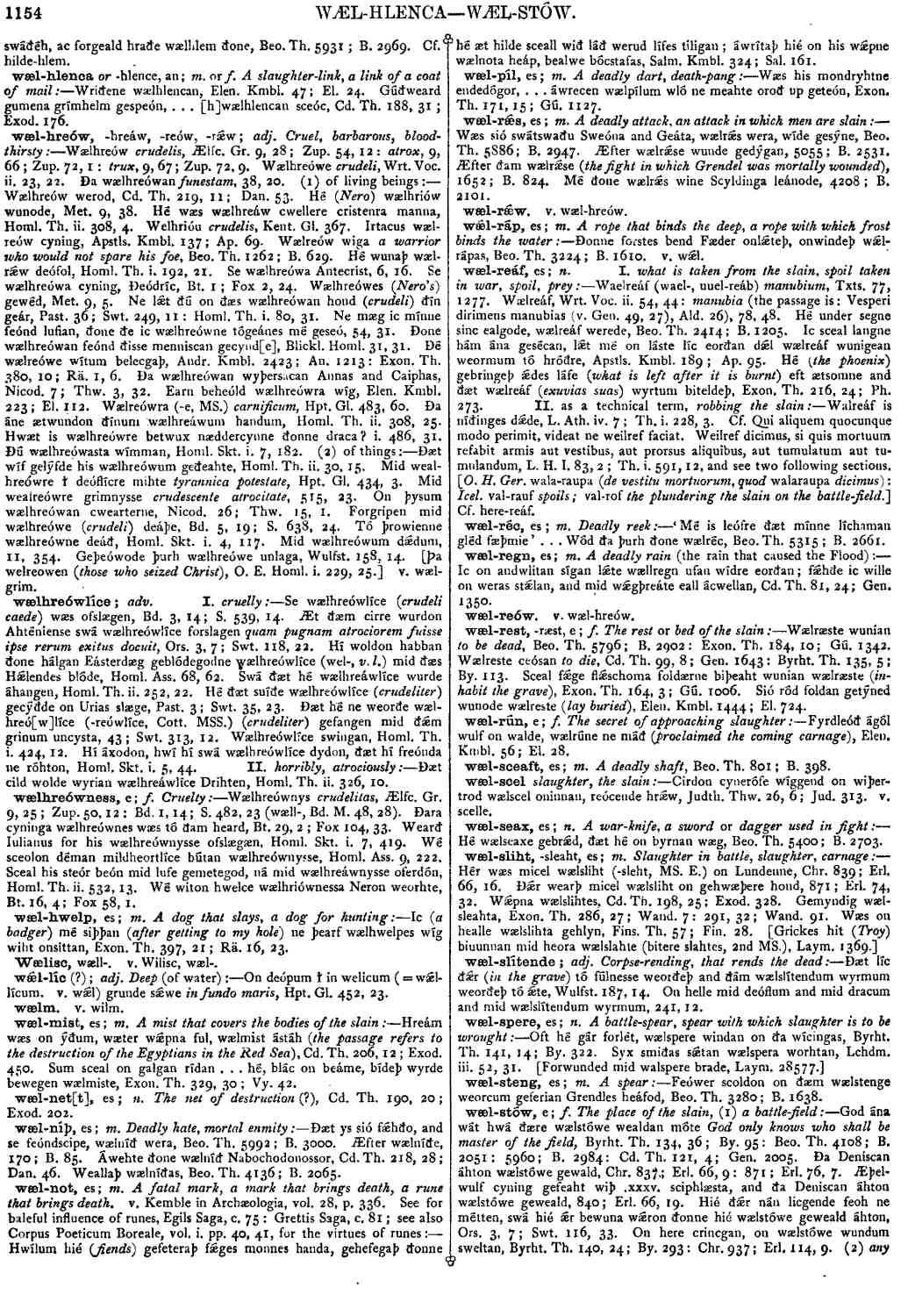
wæl-stów
- noun [ feminine ]
Grammar
The place of the slain,
a battle-field
-
God ána wát hwá ðære wælstówe wealdan móte
God only knows who shall be master of the field,
- Byrht. Th. 134, 36 ;
- By. 95: Beo. Th. 4108 ;
- B. 2051: 5960 ;
- B. 2984: Cd. Th. 121, 4 ;
- Gen. 2005.
-
Ða Deniscan áhton wælstówe gewald,
- Chr. 837 ;
- Erl. 66, 9: 871 ;
- Erl. 76, 7.
-
Æþelwulf cyning gefeaht wiþ .xxxv. sciphlæsta, and ða Deniscan áhton wælstówe geweald,
- 840;
- Erl. 66, 19.
-
Hié ðǽr nán licgende feoh ne métten, swá hié ǽr bewuna wǽron ðonne hié wælstówe geweald áhton,
- Ors. 3, 7 ;
- Swt. 116, 33.
-
On here crincgan, on wælstówe wundum sweltan,
- Byrht. Th. 140, 24 ;
- By. 293: Chr. 937 ;
- Erl. 114, 9.
any
place where there is slaughter
-
Him Loth gewát of byrig (Sodom, about to be destroyed) gangan, wælstówe fyrr,
- Cd. Th. 156, 23 ;
- Gen. 2593.
Etymology
O.H. Ger. wal-stat
:
Dan. val-plads battle-field,
beholde valpladsen to remain master of the field
.]
Linked entries
v.
hreá-wíc.
Entry information
Citation
Bosworth, Joseph. “wæl-stów.” In An Anglo-Saxon Dictionary Online, edited by Thomas Northcote Toller, Christ Sean, and Ondřej Tichy. Prague: Faculty of Arts, Charles University, 2014. https://bosworthtoller.com/34360.
Checked: 2