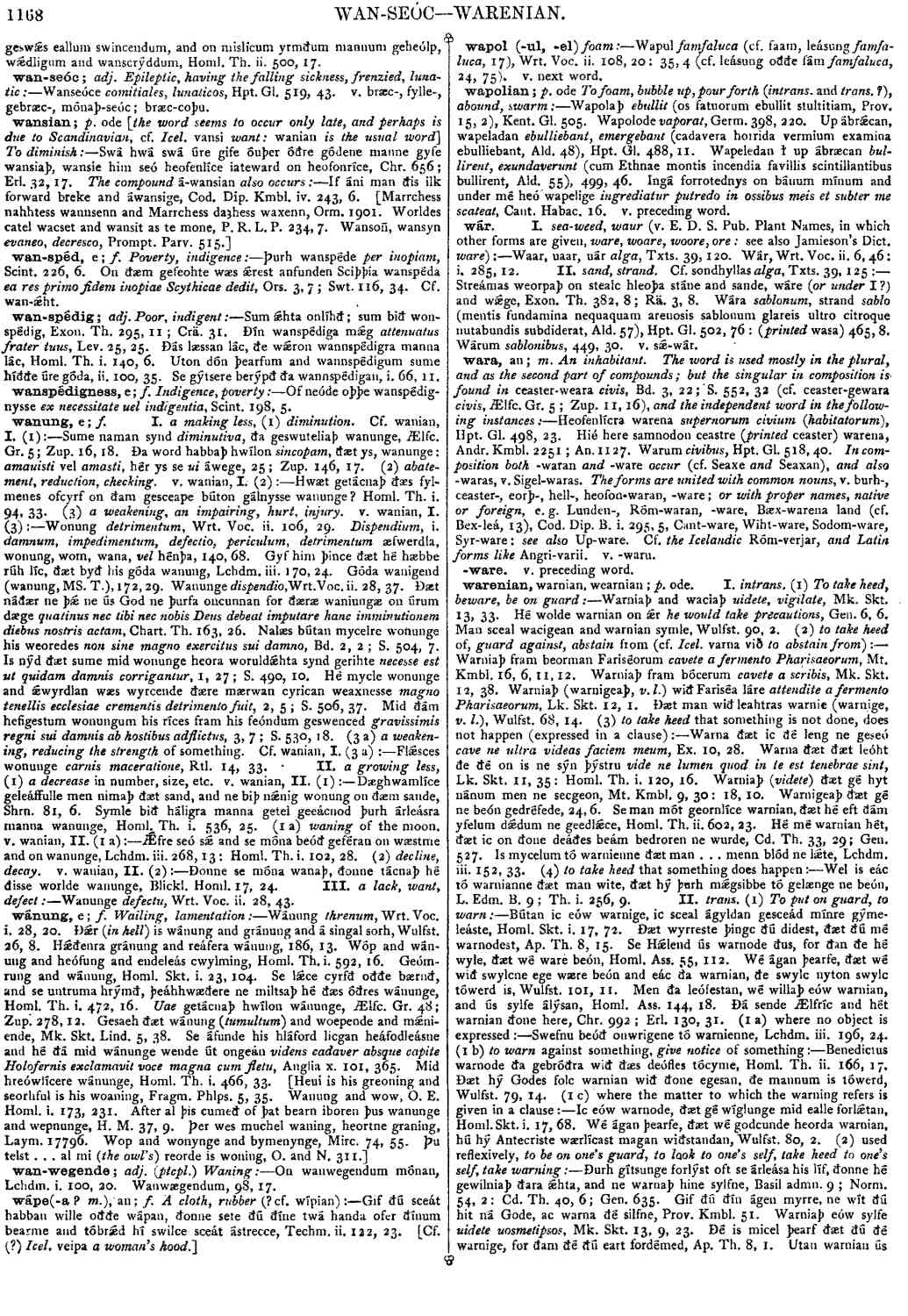
wara
- noun [ masculine ]
Grammar
An inhabitant.
- Bd. 3, 22 ;
- S. 552, 32
- Ælfc. Gr. 5 ;
- Zup. 11, 16
-
Heofenlícra warena
supernorum civium (habitatorum),
- Hpt. Gl. 498, 23.
-
Hié here samnodon ceastre (printed ceaster) warena,
- Andr. Kmbl. 2251 ;
- An. 1127.
-
Warum
civibus,
- Hpt. Gl. 518, 40.
In composition both -waran and -ware occur (cf. Seaxe and Seaxan), and also -waras, v. Sigel-waras. The forms are united with common nouns, v. burh-, ceaster-, eorþ-, hell-, heofon-waran, -ware; or with proper names, native or foreign, e. g. Lunden-, Róm-waran, -ware, Bæx-warena land (cf. Bex-leá, 13),
- Cod. Dip. B. i. 295, 5
Entry information
Citation
Bosworth, Joseph. “wara.” In An Anglo-Saxon Dictionary Online, edited by Thomas Northcote Toller, Christ Sean, and Ondřej Tichy. Prague: Faculty of Arts, Charles University, 2014. https://bosworthtoller.com/34695.
Checked: 1