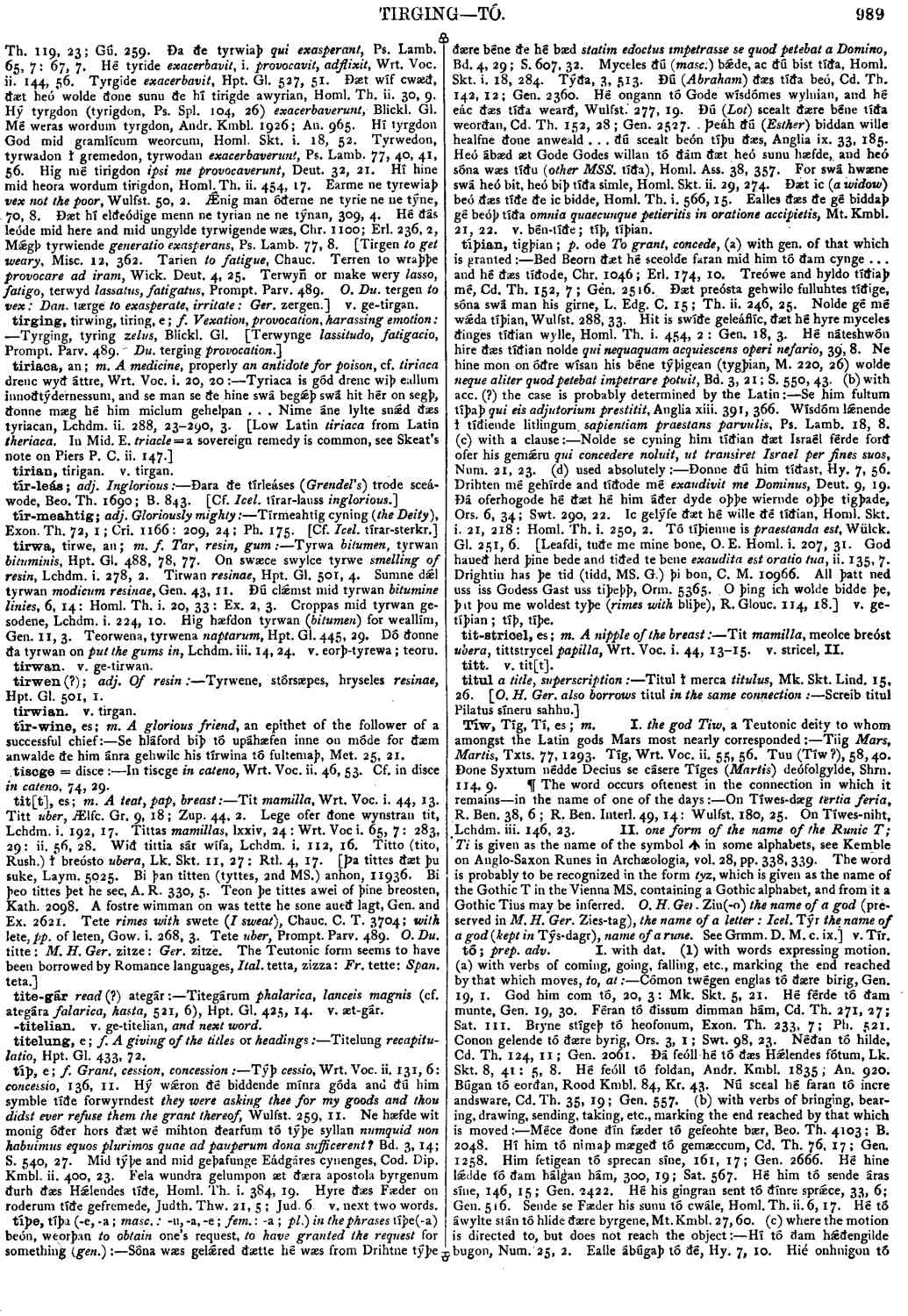
tíþian
- verb [ weak ]
-
Bed Beorn ðæt hé sceolde faran mid him tó ðam cynge . . . and hé ðæs tíðode,
- Chr. 1046;
- Erl. 174, 10.
-
Treówe and hyldo tíðiaþ mé,
- Cd. Th. 152, 7;
- Gen. 2516.
-
Ðæt preósta gehwilc fulluhtes tíðige, sóna swá man his girne,
- L. Edg. C. 15;
- Th. ii. 246, 25.
-
Nolde gé mé wǽda tíþian,
- Wulfst. 288, 33.
-
Hit is swíðe geleáflíc, ðæt hé hyre myceles ðinges tíðian wylle,
- Homl. Th. i. 454, 2 :
- Gen. 18, 3.
-
Hé náteshwón hire ðæs tíðian nolde
dui nequaquam acquiescens operi nefario,
- 39, 8.
-
Ne hine mon on óðre wísan his béne týþigean (tygþian, M. 220, 26) wolde
neque aliter quod petebat impetrare potuit,
- Bd. 3, 21;
- S. 550, 43.
-
Se him fultum tíþaþ
qui eis adjutorium prestitit,
- Anglia xiii. 391, 366.
-
Wísdóm lǽnende ł tíðiende litlingum
sapientiam praestans parvulis,
- Ps. Lamb. 18, 8.
-
Nolde se cyning him tíðian ðæt Israel férde forð ofer his gemǽru
qui concedere noluit, ut transiret Israel per fines suos,
- Num. 21, 23.
-
Ðonne ðú him tíðast,
- Hy. 7, 56.
-
Drihten mé gehírde and tíðode mé
exaudivit me Dominus,
- Deut. 9, 19.
-
Ðá oferhogode hé ðæt hé him áðer dyde oþþe wiernde oþþe tigþade,
- Ors. 6, 34;
- Swt. 290, 22.
-
Ic gelýfe ðæt hé wille ðé tíðian,
- Homl. Skt. i. 21, 218 :
- Homl. Th. i. 250, 2.
-
Tó tíþienne is
praestanda est,
- Wülck. Gl. 251, 6.
Leafdi, tuðe me mine bone,
- O. E. Homl. i. 207, 31.
-
God haueð herd þine bede and tiðed
te bene exaudita est oratio tua,
- ii. 135, 7.
Drightin has þe tid (tidd, MS. G.) þi bon,
- C. M. 10966.
All þatt ned uss iss Godess Gast uss tiþeþþ,
- Orm. 5365.
O þing ich wolde bidde þe, þit þou me woldest tyþe (rimes with bliþe),
- R. Glouc. 114, 18.
Bosworth, Joseph. “tíþian.” In An Anglo-Saxon Dictionary Online, edited by Thomas Northcote Toller, Christ Sean, and Ondřej Tichy. Prague: Faculty of Arts, Charles University, 2014. https://bosworthtoller.com/30582.
Checked: 2