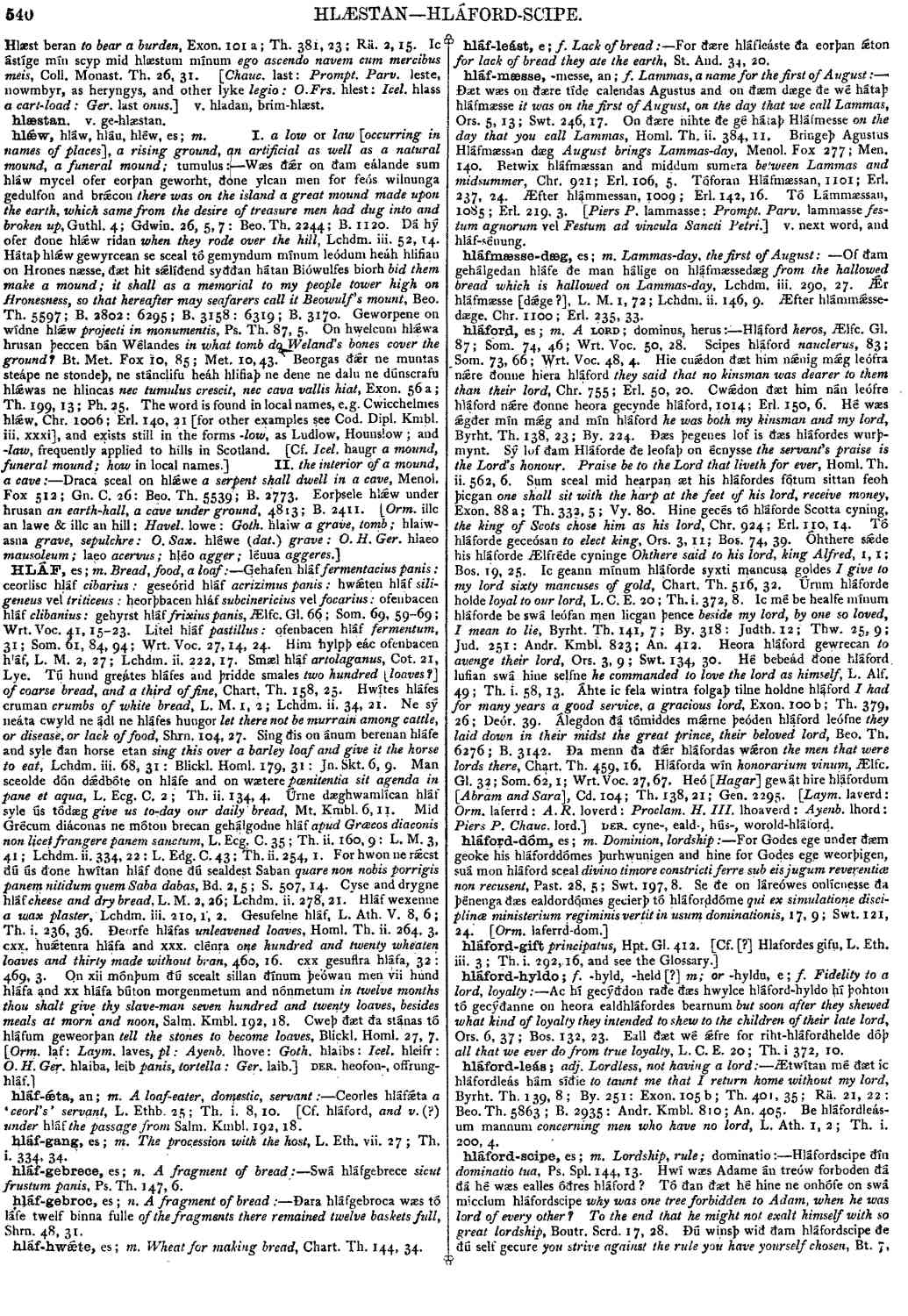
HLÁF
- noun [ masculine ]
-
Gehafen hláf
fermentacius panis:
ceorlisc hláf
cibarius:
geseórid hláf
acrizimus panis:
hwǽten hláf
siligeneus vel triticeus:
heorþbacen hláf
subcinericius vel focarius:
ofenbacen hláf
clibanius:
gehyrst hláf
frixius panis,
- Ælfc. Gl. 66;
- Som. 69, 59-69;
- Wrt. Voc. 41, 15-23.
-
Litel hláf
pastillus:
ofenbacen hláf
fermentum,
- 31;
- Som. 61, 84, 94;
- Wrt. Voc. 27, 14, 24.
-
Him hylpþ eác ofenbacen hláf,
- L. M. 2, 27;
- Lchdm. ii. 222, 17.
-
Smæl hláf
artolaganus,
- Cot. 21, Lye.
Tú hund greátes hláfes and þridde smales
two hundred [loaves?] of coarse bread, and a third of fine,
- Chart. Th. 158, 25.
-
Hwítes hláfes cruman
crumbs of white bread,
- L. M. 1, 2;
- Lchdm. ii. 34, 21.
-
Ne sý neáta cwyld ne ádl ne hláfes hungor
let there not be murrain among cattle, or disease, or lack of food,
- Shrn. 104, 27.
-
Sing ðis on ánum berenan hláfe and syle ðan horse etan
sing this over a barley loaf and give it the horse to eat,
- Lchdm. iii. 68, 31:
- Blickl. Homl. 179, 31:
- Jn. Skt. 6, 9.
-
Man sceolde dón dǽdbote on hláfe and on wætere
pœnitentia sit agenda in pane et aqua,
- L. Ecg. C. 2;
- Th. ii. 134, 4.
-
Úrne dæghwamlícan hláf syle ús tódæg
give us to-day our daily bread,
- Mt. Kmbl. 6, 11.
-
Mid Grécum diáconas ne móton brecan gehálgodne hláf
apud Græcos diaconis non licet frangere panem sanctum,
- L. Ecg. C. 35;
- Th. ii. 160, 9:
- L. M. 3, 41;
- Lchdm. ii. 334, 22:
- L. Edg. C. 43;
- Th. ii. 254, 1.
-
For hwon ne rǽcst ðú ús ðone hwítan hláf ðone ðú sealdest Saban
quare non nobis porrigis panem nitidum quem Saba dabas,
- Bd. 2, 5;
- S. 507, 14.
-
Cyse and drygne hláf
cheese and dry bread,
- L. M. 2, 26;
- Lchdm. ii. 278, 21.
-
Hláf wexenne
a wax plaster,
- Lchdm. iii. 210, 1, 2.
-
Gesufelne hláf,
- L. Ath. V. 8, 6; Th. i. 236, 36.
-
Ðeorfe hláfas
unleavened loaves,
- Homl. Th. ii. 264. 3.
-
cxx. huǽtenra hláfa and xxx. clénra
one hundred and twenty wheaten loaves and thirty made without bran,
- 460, 16.
-
cxx gesuflra hláfa,
- 32: 469, 3.
-
On xii mónþum ðú scealt sillan ðínum þeówan men vii hund hláfa and xx hláfa búton morgenmetum and nónmetum
in twelve months thou shalt give thy slave-man seven hundred and twenty loaves, besides meals at morn and noon,
- Salm. Kmbl. 192, 18.
-
Cweþ ðæt ða stánas tó hláfum geweorþan
tell the stones to become loaves,
- Blickl. Homl. 27, 7.
Bosworth, Joseph. “HLÁF.” In An Anglo-Saxon Dictionary Online, edited by Thomas Northcote Toller, Christ Sean, and Ondřej Tichy. Prague: Faculty of Arts, Charles University, 2014. https://bosworthtoller.com/19170.
Checked: 2