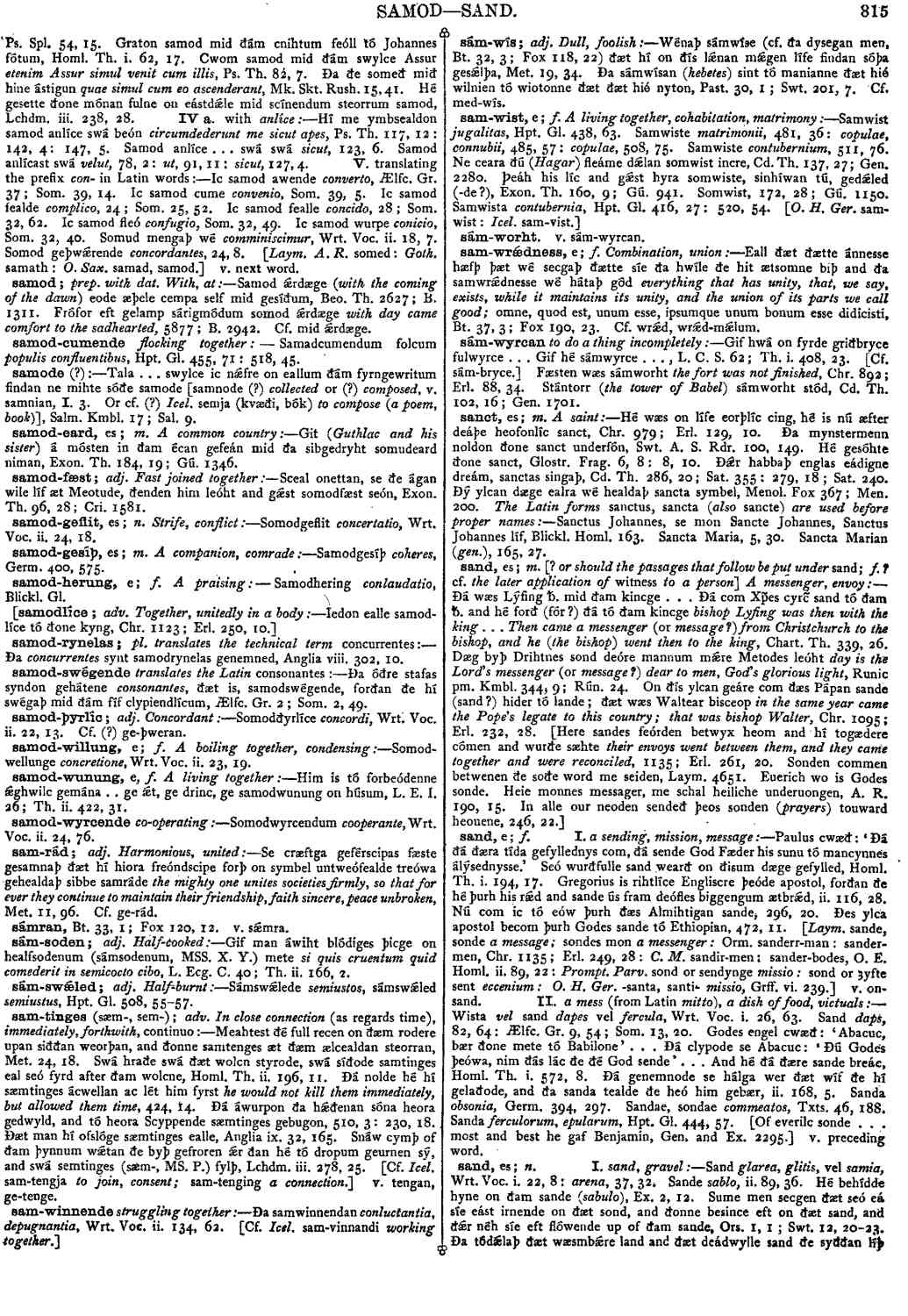
sand
- noun [ masculine ]
-
Ðá wæs Lýfing ƀ mid ðám kincge . . . Ðá com Xp̃es cyrc̃ sand tó ðám ƀ and hé forð (fór ?) ðá tó ðám kincge
bishop Lyfing was then with the king. . . Then came a messenger (or message? ) from Christchurch to the bishop, and he (the bishop) went then to the king,
- Chart. Th. 339, 26 .
-
Dæg byþ Drihtnes sond deóre mannum mǽre Metodes leóht
day is the Lord's messenger (or message?) dear to men, God's glorious light,
- Runic pm. Kmbl. 344, 9 ;
- Rún. 24 .
-
On ðís ylcan geáre com ðæs Pápan sande (sand?) hider tó lande; ðæt wæs Waltear bisceop
in the same year came the Pope's legate to this country; that was bishop Walter,
- Chr. 1095 ;
- Erl. 232, 28 .
Here sandes feórden betwyx heom and hí togædere cómen and wurðe sæhte
their envoys went between them, and they came together and were reconciled,
- 1135 ;
- Erl. 261, 20 .
Sonden commen betwenen ðe soðe word me seiden,
- Laym. 4651.
-
Euericb wo is Godes sonde. Heie monnes messager, me schal heiliche underuongen,
- A. R. 190, 15.
In alle our neoden sendeð þeos sonden (prayers) touward heouene,
- 246, 22.
Bosworth, Joseph. “sand.” In An Anglo-Saxon Dictionary Online, edited by Thomas Northcote Toller, Christ Sean, and Ondřej Tichy. Prague: Faculty of Arts, Charles University, 2014. https://bosworthtoller.com/26386.
Checked: 2