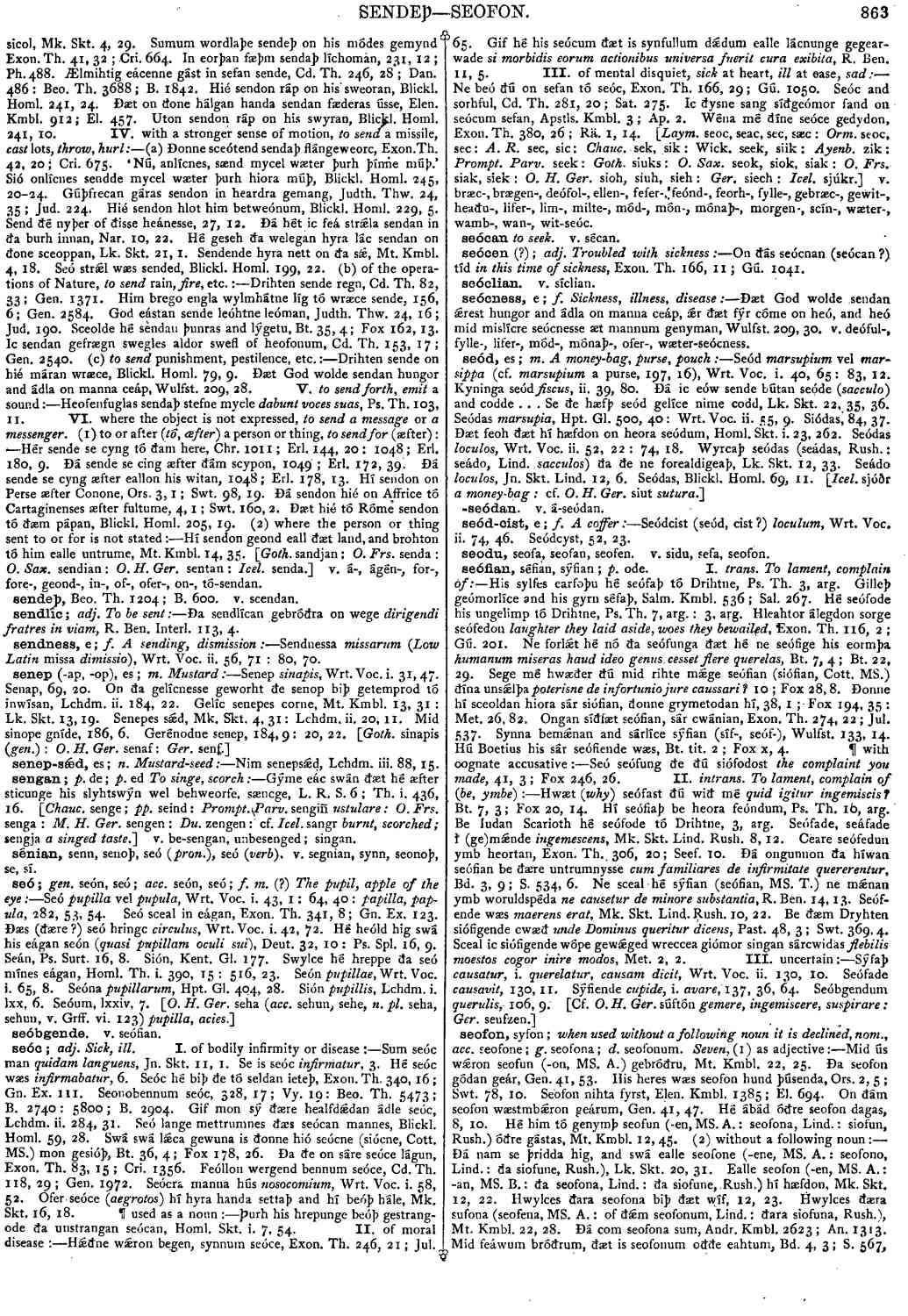
seófian
- verb [ weak ]
-
His sylfes earfoþu hé seófaþ tó Drihtne,
- Ps. Th. 3, arg .
-
Gilleþ geómorlíce and his gyrn séfaþ,
- Salm. Kmbl. 536 ;
- Sal. 267 .
-
Hé seófode his ungelimp tó Drihtne,
- Ps. Th. 7, arg. :
- 3, arg .
-
Hleahtor álegdon sorge seófedon
laughter they laid aside, woes they bewailed.
- Exon. Th. 116, 2 ;
- Gú. 201 .
-
Ne forlǽt hé nó ða seófunga ðæt hé ne seófige his eormþa
humanum miseras haud ideo genus cesset flere querelas
- Bt. 7, 4 ;
- Bt. 22, 29 .
-
Sege mé hwæðer ðú mid rihte mǽge seófian (siófian, Cott. MS.) ðína unsǽlþa
poterisne de infortunio jure caussari ?
- 10 ;
- Fox 28, 8 .
-
Ðonne hí sceoldan hiora sár siófian, ðonne grymetodan hí,
- 38, 1 ;
- Fox 194, 35 :
- Met. 26, 82 .
-
Ongan síðfæt seófian, sár cwánian,
- Exon. Th. 274, 22 ;
- Jul. 537 .
-
Synna bemǽnan and sárlíce sýfian (síf-, seóf-),
- Wulfst. 133, 14 .
-
Hú Boetius his sár seófiende wæs,
- Bt. tit. 2 ;
- Fox x, 4 .
-
Seó seófung ðe ðú siófodost
the complaint you made,
- 41, 3 ;
- Fox 246, 26 .
-
Hwæt (why) seófast ðú wið mé
quid igitur ingemiscis ?
- Bt. 7, 3 ;
- Fox 20, 14 .
-
Hí seófiaþ be heora feóndum,
- Ps. Th. 10, arg .
-
Be Iudan Scarioth hé seófode tó Drihtne,
- 3, arg .
-
Seófade, seáfade ł (ge)mǽnde
ingemescens
- Mk. Skt. Lind. Rush. 8, 12 .
-
Ceare seófedun ymb heortan,
- Exon. Th. 306, 20 ;
- Seef. 10 .
-
Ðá ongunnon ða híwan seófian be ðære untrumnysse
cum familiares de infirmitate quererentur
- Bd. 3, 9 ;
- S. 534, 6 .
-
Ne sceal hé sýfian (seófian, MS. T.) ne mǽnan ymb woruldspéda
ne causetur de minore substantia
- R. Ben. 14, 13 .
-
Seófende wæs
maerens erat
- Mk. Skt. Lind. Rush. 10, 22 .
-
Be ðæm Dryhten siófigende cwæð
unde Dominus queritur dicens
- Past. 48, 3 ;
- Swt. 369, 4 .
-
Sceal ic siófigende wópe gewǽged wreccea giómor singan sárcwidas
flebilis moestos cogor inire modos
- Met. 2, 2 ,
-
Sýfaþ
causatur, i. querelatur, causam dicit,
- Wrt. Voc. ii. 130, 10 .
-
Seófade
causavit,
- 130, 11 ,
-
Sýfiende
cupide, i. avare
- 137, 36, 64 .
-
Seóbgendum
querulis
- 106, 9 .
Bosworth, Joseph. “seófian.” In An Anglo-Saxon Dictionary Online, edited by Thomas Northcote Toller, Christ Sean, and Ondřej Tichy. Prague: Faculty of Arts, Charles University, 2014. https://bosworthtoller.com/27455.
Checked: 2