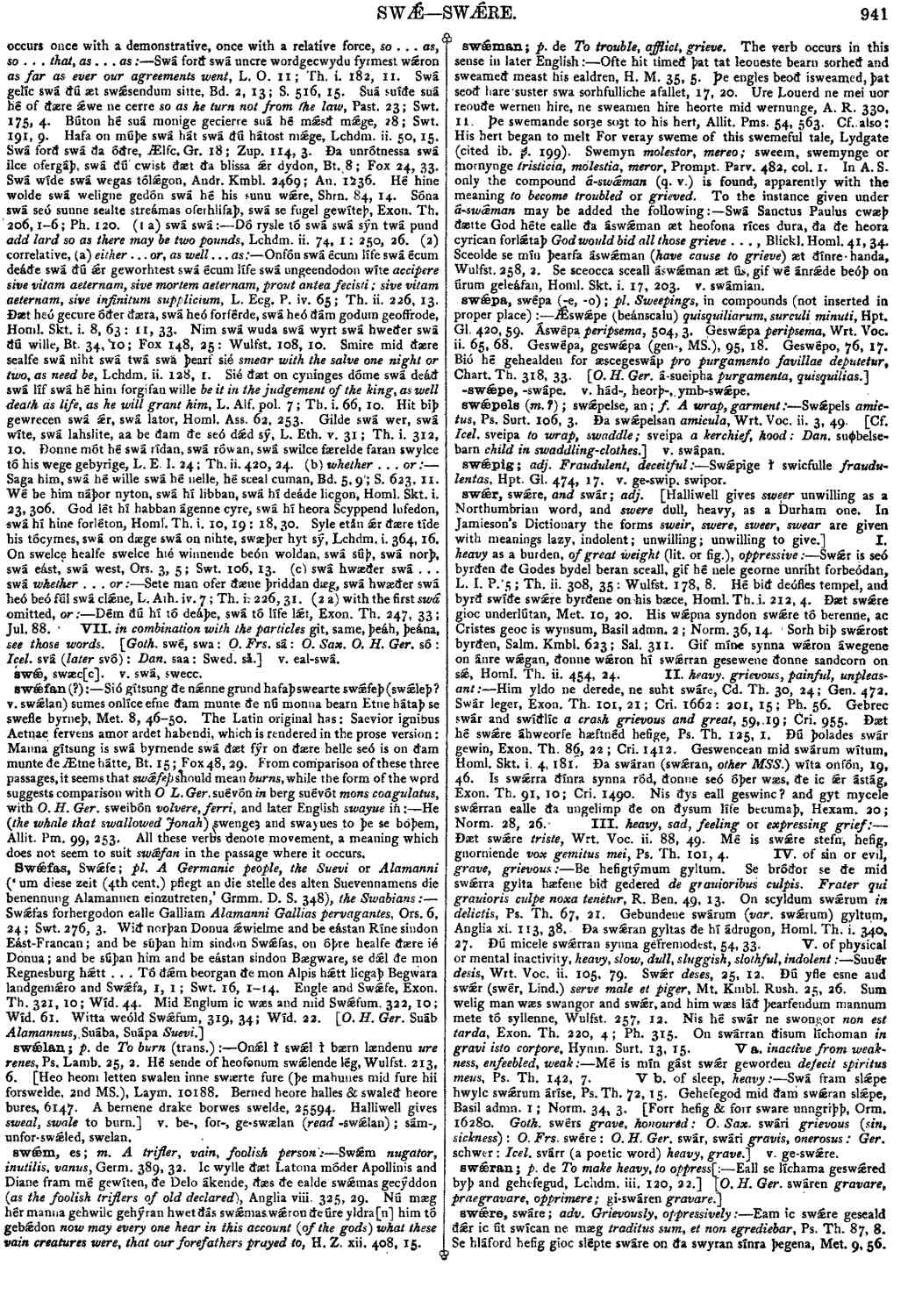
swǽr
- adjective
- Halliwell
- Jamieson's Dictionary
-
Swǽr is seó byrðen ðe Godes bydel beran sceall, gif hé nele georne unriht forbeódan,
- L. I. P. 5 ;
- Th. ii. 308, 35: Wulfst. 178, 8.
-
Hé bið deófles tempel, and byrð swíðe swǽre byrðene on his bæce,
- Homl. Th. i. 212, 4.
-
Ðæt swǽre gioc underlútan,
- Met. 10, 20.
-
His wǽpna syndon swǽre tó berenne, ac Cristes geoc is wynsum,
- Basil admn. 2 ;
- Norm. 36, 14.
-
Sorh biþ swǽrost byrðen,
- Salm. Kmbl. 623 ;
- Sal. 311.
-
Gif míne synna wǽron áwegene on ánre wǽgan, ðonne wǽron hí swǽrran gesewene ðonne sandcorn on sǽ,
- Homl. Th. ii. 454, 24.
-
Him yldo ne derede, ne suht swáre,
- Cd. Th. 30, 24 ;
- Gen. 472.
-
Swár leger,
- Exon. Th. 101, 21 ;
- Cri. 1662 : 201, 15 ;
- Ph. 56.
-
Gebrec swár and swíðlíc
a crash grievous and great
,- 59, 19 ;
- Cri. 955.
-
Ðæt hé swǽre áhweorfe hæftnéd hefige,
- Ps. Th. 125, 1.
-
Ðú þolades swár gewin,
- Exon. Th. 86, 22 ;
- Cri. 1412.
-
Geswencean mid swárum wítum,
- Homl. Skt. i. 4, 181.
-
Ða swáran (swǽranother MSS .), wíta onfón,
- 19, 46.
-
Is swǽrra ðínra synna ród, ðonne seó óþer wæs, ðe ic ǽr ástág,
- Exon. Th. 91, 10 ;
- Cri. 1490.
-
Nis ðys eall geswinc? and gyt mycele swǽrran ealle ða ungelimp ðe on ðysum lífe becumaþ,
- Hexam. 20 ;
- Norm. 28, 26.
-
Ðæt swǽre
triste
,- Wrt. Voc. ii. 88, 49.
-
Mé is swǽre stefn, hefig, gnorniende
vox gemitus mei
,- Ps. Th. 101, 4.
-
Be hefigtýmum gyllum. Se bróðor se ðe mid swǽrra gylta hæfene bið gedered
de grauioribus culpis. Frater qui grauioris culpe noxa tenetur
,- R. Ben. 49, 13.
-
On scyldum swǽrum
in delictis
,- Ps. Th. 67, 21.
-
Gebundene swárum (var. swǽrum) gyltum,
- Anglia xi. 113, 38.
-
Ða swǽran gyltas ðe hí ádrugon,
- Homl. Th. i. 340, 27.
-
Ðú micele swǽrran synna gefremodest,
- 54, 33.
-
Snuér
desis
,- Wrt. Voc. ii. 105, 79.
-
Swǽr
deses
,- 25, 12.
-
Ðú yfle esne and swǽr (swér, Lind.)
serve male et piger
,- Mt. Kmbl. Rush. 25, 26.
-
Sum welig man wæs swangor and swǽr, and him wæs láð þearfendum mannum mete tó syllenne,
- Wulfst. 257, 12.
-
Nis hé swár ne swongor
non est tarda
,- Exon. Th. 220, 4 ;
- Ph. 315.
-
On swárran ðisum líchoman
in gravi isto corpore
,- Hymn. Surt. 13, 15.
-- Mé is mín gást swǽr geworden
defecit spiritus meus,
- Ps. Th. 142, 7.
-
:-- Swá fram slǽpe hwylc swǽrum áríse,
- Ps. Th. 72, 15.
-
Gehefegod mid ðam swǽran slǽpe,
- Basil admn. 1 ;
- Norm. 34, 3.
Bosworth, Joseph. “swǽr.” In An Anglo-Saxon Dictionary Online, edited by Thomas Northcote Toller, Christ Sean, and Ondřej Tichy. Prague: Faculty of Arts, Charles University, 2014. https://bosworthtoller.com/29506.
Checked: 2