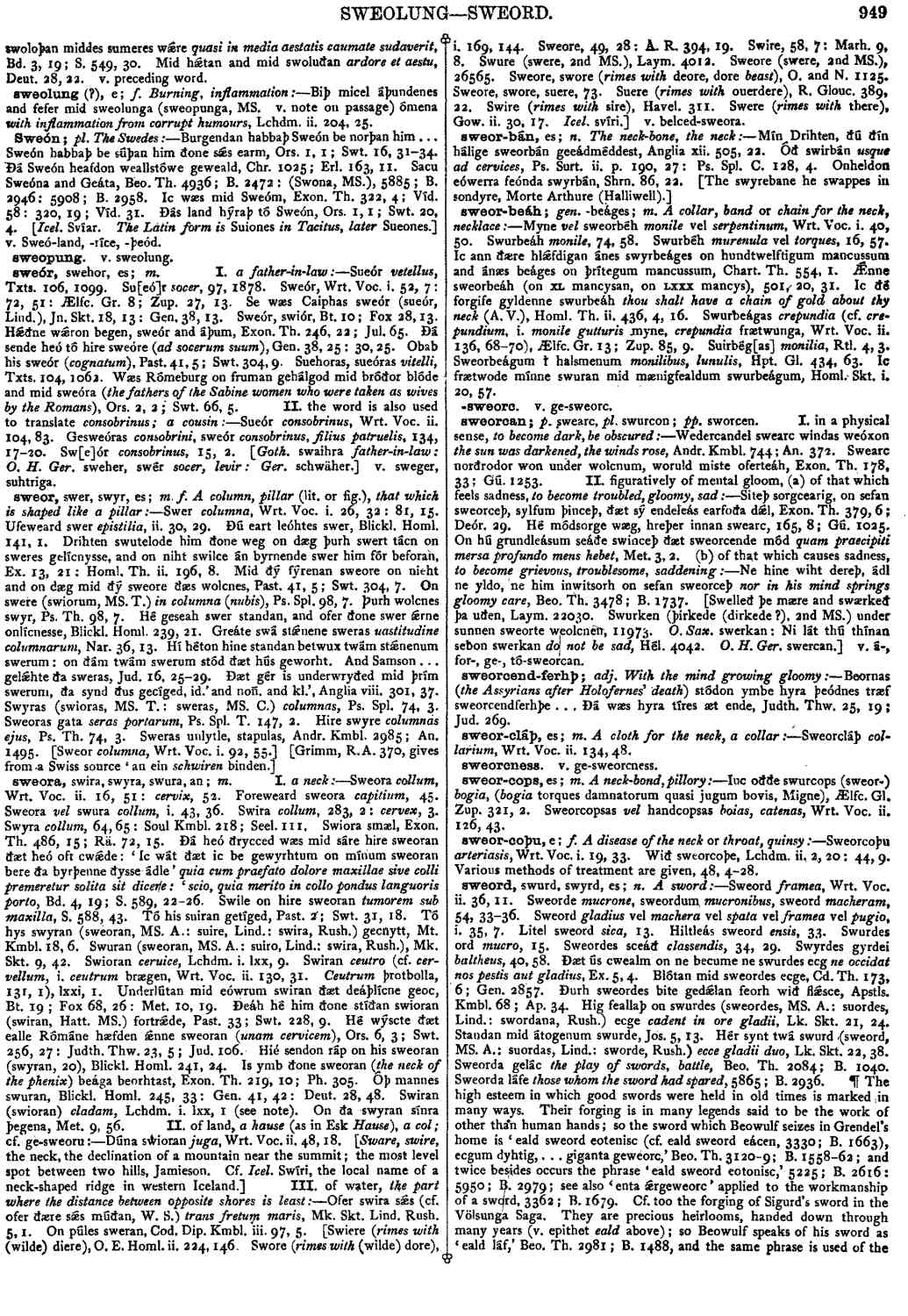
sweord
- noun [ neuter ]
-
Sweord
framea,
- Wrt. Voc. ii. 36, 11.
-
Sweorde mucrone, sweordum mucronibus, sweord
macheram,
- 54, 33-36.
-
Sweord
gladius vel machera vel spata vel framea vel pugio,
- i. 35, 7.
-
Litel sweord
sica,
- 13.
-
Hiltleás sweord
ensis,
- 33.
-
Swurdes ord
mucro,
- 15.
-
Sweordes sceáð
classendis,
- 34, 29.
-
Swyrdes gyrdei
baltheus,
- 40, 58.
-
Ðæt ús cwealm on ne becume ne swurdes ecg
ne occidat nos pestis aut gladius,
- Ex. 5, 4.
-
Blótan mid sweordes ecge,
- Cd. Th. 173, 6 ;
- Gen. 2857.
-
Ðurh sweordes bite gedǽlan feorh wið flǽsce,
- Apstls. Kmbl. 68 ;
- Ap. 34.
-
Hig feallaþ on swurdes (sweordes, MS. A.: suordes, Lind.: swordana, Rush.) ecge
cadent in ore gladii,
- Lk. Skt. 21, 24.
-
Standan mid átogenum swurde,
- Jos. 5, 13.
-
Hér synt twá swurd (sweord, MS. A.: suordas, Lind.: sworde, Rush.)
ecce gladii duo,
- Lk. Skt. 22, 38.
-
Sweorda gelác
the play of swords, battle,
- Beo. Th. 2084 ;
- B. 1040.
-
Sweorda láfe
those whom the sword had spared,
- 5865 ;
- B. 2936.
- 
The high esteem in which good swords were held in old times is marked in many
ways. Their forging is in many legends said to be the work of other than human
hands; so the sword which Beowulf seizes in Grendel's nome is
'eald sweord eotenisc (cf. eald sweord eácen, 3330; B. 1663), ecgum dyhtig, . . . giganta geweorc,'
- Beo. Th. 3120-9 ;
- B. 1558-62
'eald sweord eotonisc,
'- 5225 ;
- B. 2616: 5950 ;
- B. 2979 ;
- 3362 ;
- B. 1679.
- Beo. Th. 2981 ;
- B. 1488 ,
- 1595 ;
- B. 795.
- In reference to the sword given by Beowulf to the Dane who had guarded his ship, it
is said that the recipient
'syððan wæs on meodobence mádme ðý weorðra, yrfeláfe,'
- 3810 ;
- B. 1903 ;
'næs mid Geátum sincmáðþum sélra on sweordes hád,'
- 4389-93 ;
- B. 2191-3 ;
'gomel swyrd, Eánmundes láf,'
- 5216 ;
- B. 2611 ;
- 2921 ;
- B. 1458 .
-
The same point may be illustrated from other than poetical sources. Thus
in Alfred's will it is said that he leaves
'Æþeréde ealdormenn án sweord on hundteóntigum mancusum,'
- Chart. Th. 489, 32 ;
- in
another will is the passage
'Freoðomunde fóe tó mínum sweorde, and ágefe ðéræt feówer ðúsenda,'
- 471, 23
'mid ðam sylfrenan hylte and ðone gyldenan fetels,'
- 558, 10
'ðat Eádmund king mé selde on hund*-*tuelftian mancusas goldes and fóur pund silueres on ðan fetelse,'
- 505, 28
-
Indeed the sword is often mentioned in wills. The importance of the sword is
further marked by its receiving a name. The sword with which Beowulf is armed for
his attack on Grendel's mother is named Hrunting, and to the praise of this weapon
the poet devotes several lines,
- Beo. Th. 2914-33 ;
- B. 1455-64 ;
'Nægling . . . gomol and grǽgmmǽl'
that he fights,- 5354;
- B. 2680.
- Wald. 4 ;
- Vald. 1, 3 .
-
And elsewhere the same point may be noted, e. g. in the Nibelungenlied. 'daz
Nibelunges swert. . . Palmunc was genant;' and this weapon plays a part in the
drama to the last scene. In Scandinavian story there is Hákon's sword 'kvernbítr,'
which king Athelstan gave him, and Egill has his sword that he called 'Naðr.' See,
too, the story of the Cid and the two swords, Colada and Tizona, which he gave to
his sons-in-law, the Infantes of Carrion, and which he claimed from them after
their unworthy treatment of their wives, Chronica del Cid, c. cclii. Of the value
of the sword and of the decoration bestowed upon it, of the shape or colouring, of
the make, many epithets and phrases speak. In the Gnomic verses it is said,
'Gold geríseþ on guman sweorde,'
- Exon. Th. 341, 15 ;
- Gn. Ex. 126 ;
'máðm in healle, goldhilted sweord'
is mentioned,- 437, 27 ;
- Rä. 56, 14 .
-
See, too, the passages quoted under
seolfor-hilt, -hilted. In the dragon's hoard are
'dýre swyrd,'
- Beo. Th. 6089 ;
- B. 3048 :
- the sword which Beowulf seized in Grendel's retreat was golden-hilted,
- 3358 ;
- B. 1677,
'wæs on ðǽm scennum scíran goldes þurh rúnstafas gesǽd, hwam ðæt sweord geworht, írena cyst, ǽrest wǽre, wreoþenhilt and wyrmfáh,'
- 3390-3400 ;
- B. 1694-8.
- Beowulf lays aside his
'hyrsted sweord, írena cyst,'
- Beo. Th. 1349 ;
- B. 672
'bunden golde,'
- 3805 ;
- B. 1901
'fáh and fǽted,'
- 5395 ;
- B. 2700.
-
Byrhtnoth's sword is
'fealohilte,'
- Byrht. Th. 136, 45 ;
- By. 166 ;
'gerénod,'
- 35 ;
- By. 161.
-
Beowulf's Nægling is
'grǽgmǽl,'
- Beo. Th. 5357 ;
- B. 2681
'scírmǽled,'
- Judth. Thw. 24, 38 ;
- Jud. 230
'hring-mǽled,'
- Cd. Th. 120, 10 ;
- Gen. 1992
- Abraham girds himself
'grǽgan sweorde,'
- 173, 22 ;
- Gen. 2865
- the Hebrews fight
'fágum sweordum,'
- Judth. Thw. 24, 18 ;
- Jud. 194: 25, 17 ;
- Jud. 264.
-
The sword is
'brád,'
- 26, 9 ;
- Jud. 318: Byrht. Th. 132, 12 ;
- By. 15
brád and brúnecg,
- 136, 38 ;
- By. 163
'gód,'
- 138, 58 ;
- By. 237 ;
'heard,'
- Beo. Th. 5966 ;
- B. 2987: 5269 ;
- B. 2638: Exon. Th. 325, 32 ;
- Víd. 120 :
'heardecg,'
- Beo. Th. 2581 ;
- B. 1288 :
'ecgum dyhtig,'
- 2578 ;
- B. 1287: Cd. Th. 120, 11 ;
- Gen. 1993 :
'ecgum gecost,'
- Judth. Thw. 34, 39 ;
- Jud. 231 :
stýled,
- Exon. Th. 42, 28 ;
- Cri. 679.
- Grmm. Gesch. D. S. p. 12.
Bosworth, Joseph. “sweord.” In An Anglo-Saxon Dictionary Online, edited by Thomas Northcote Toller, Christ Sean, and Ondřej Tichy. Prague: Faculty of Arts, Charles University, 2014. https://bosworthtoller.com/29688.
Checked: 2