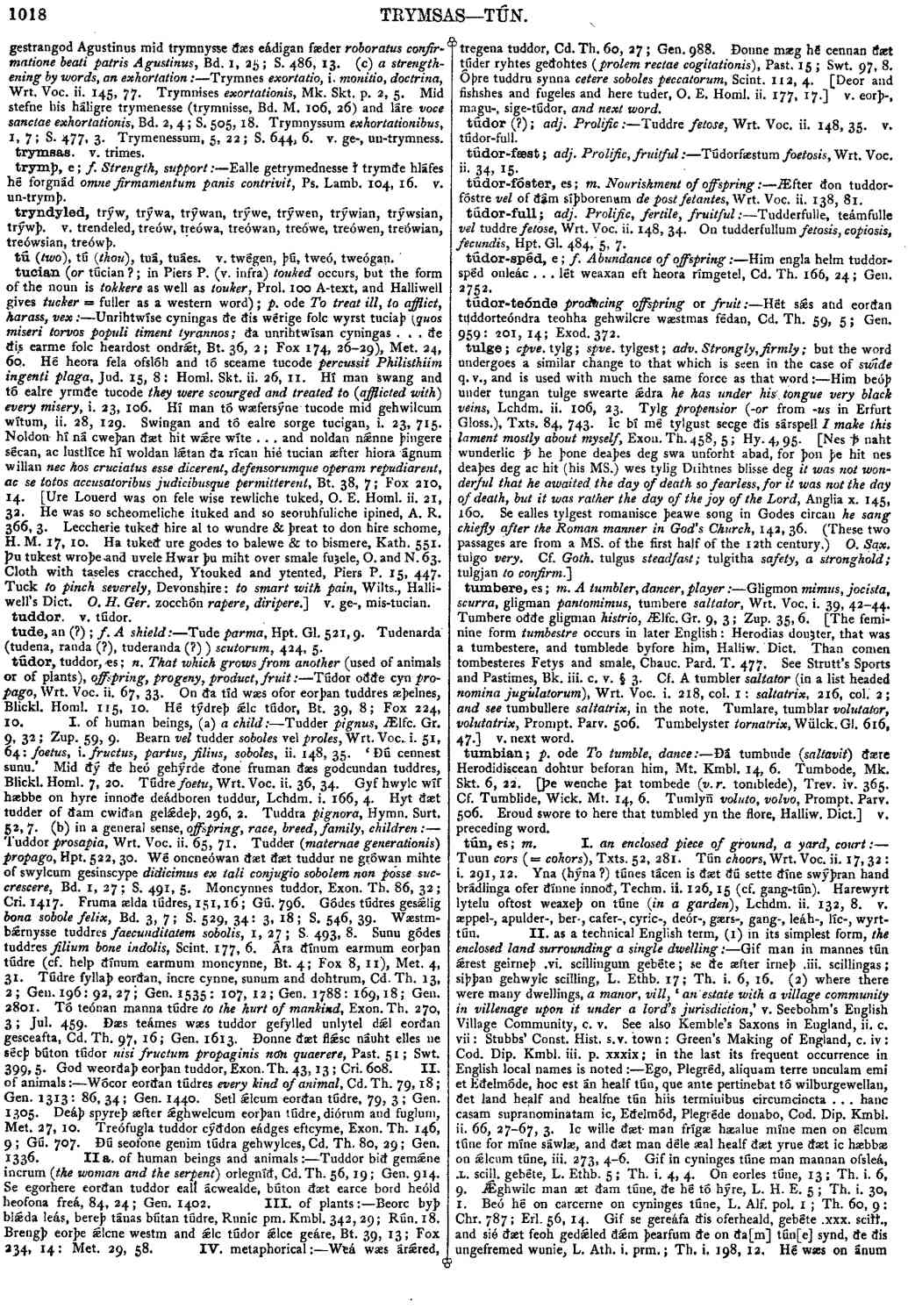
túdor
- noun [ neuter ]
-
Túdor oððe cyn
propago,
- Wrt. Voc. ii. 67, 33.
-
On ða tíd wæs ofor eorþan tuddres æþelnes,
- Blickl. Homl. 115, 10.
-
Hé týdreþ ǽlc túdor,
- Bt. 39, 8 ;
- Fox 224, 10.
-
Tudder
pignus,
- Ælfc. Gr. 9, 32 ;
- Zup. 59, 9.
-
Bearn vel tudder
soboles vel proles,foetus, fructus, partus, filius, soboles,
- Wrt. Voc. i. 51, 64: ii. 148, 35.
-
' Ðú cennest sunu. ' Mid ðý ðe heó gehýrde ðone fruman ðæs godcundan tuddres,
- Blickl. Homl. 7, 20.
-
Túdre
foetu,
- Wrt. Voc. ii. 36, 34.
-
Gyf hwylc wíf htebbe on hyre innoðe deádboren tuddur,
- Lchdm. i. 166, 4.
-
Hyt ðæt tudder of ðam cwiðan gelǽdeþ,
- 296, 2.
-
Tuddra
pignora.
- Hymn. Surt. 52, 7.
-
Tuddor
prosapia,
- Wrt. Voc. ii. 65, 71.
-
Tudder
(maternae generationis) propago,
- Hpt. 522, 30.
-
Wé oncneówan ðæt ðæt tuddur ne grówan mihte of swylcum gesinscype
didicimus ex tali conjugio sobolem non posse succrescere,
- Bd. 1, 27 ;
- S. 491, 5.
-
Moncynnes tuddor.
- Exon. Th. 86, 32 ;
- Cri. 1417.
-
Fruma ælda túdres,
- 151, 16 ;
- Gú. 796.
-
Gódes túdres gesǽlig
bona sobole felix,
- Bd. 3, 7 ;
- S. 529, 34: 3, 18 ;
- S. 546, 39.
-
Wæstmbærnysse tuddres
faecunditatem sobolis,
- 1, 27 ;
- S. 493, 8.
-
Sunu gódes tuddres
filium bone indolis,
- Scint. 177, 6.
-
Ára ðínum earmum eorþan túdre (cf. help ðínum earmum moncynne, Bt. 4; Fox 8, 11),
- Met. 4, 31.
-
Túdre fyllaþ eorðan, incre cynne, sunum and dohtrum,
- Cd. Th. 13, 2 ;
- Gen. 196. 92, 27 ;
- Gen. 1535: 107, 12 ;
- Gen. 1788: 169, 18 ;
- Gen. 2801.
-
tó teónan manna túdre
to the hurt of mankind.
- Exon. Th. 270, 3 ;
- Jul. 459.
-
Ðæs teámes wæs tuddor gefylled unlytel dǽl eorðan gesceafta,
- Cd. Th. 97, 16 ;
- Gen. 1613.
-
Ðonne ðæt flǽsc náuht elles ne sécþ búton túdor
nisi fructum propaginis non quaerere,
- Past. 51 ;
- Swt. 399, 5.
-
God weorðaþ eorþan tuddor,
- Exon. Th. 43, 13 ;
- Cri. 608.
-
Wócor eorðan túdres
every kind of animal,
- Cd. Th. 79, 18 ;
- Gen. 1313: 86, 34 ;
- Gen. 1440.
-
Setl ǽlcum eorðan túdre,
- 79, 3 ;
- Gen. 1305.
-
Deáþ spyreþ æfter ǽghwelcum eorþan túdre, diórum and fuglum,
- Met. 27, 10.
-
Treófugla tuddor cýð ðon eádges eftcyme.
- Exon. Th. 146, 9 ;
- Gú. 707.
-
Ðú seofone genim túdra gehwylces,
- Cd. Th. 80, 29 ;
- Gen. 1336.
-
Tuddor bið gemǽne incrum (the woman and the serpent) orlegníð,
- Cd. Th. 56, 19 ;
- Gen. 914.
-
Se egorhere eorðan tuddor eall ácwealde, búton ðæt earce bord heóld heofona freá,
- 84, 24 ;
- Gen. 1402.
-
Beorc byþ blǽda leás, bereþ tánas bútan túdre.
- Runic pm. Kmbl. 342, 29 ;
- Rún. 18.
-
Brengþ eorþe ǽlcne westm and ǽlc túdor ǽlce geáre,
- Bt. 39, 13 ;
- Fox 234, 14 :
- Met. 29, 58.
-
Weá wæs árǽred, tregena tuddor,
- Cd. Th. 60, 27 ;
- Gen. 988.
-
Ðonne mæg hé cennan ðæt túder ryhtes geðohtes (prolem rectae cogitationis),
- Past. 15 ;
- Scint. 97, 8.
-
Óþre tuddru synna
cetere soboles peccatorum,
- Scint. 112, 4.
-
Deor and fishshes and fugeles and here tuder,
- O. E. Homl. ii. 177, 17.
Bosworth, Joseph. “túdor.” In An Anglo-Saxon Dictionary Online, edited by Thomas Northcote Toller, Christ Sean, and Ondřej Tichy. Prague: Faculty of Arts, Charles University, 2014. https://bosworthtoller.com/31117.
Checked: 2