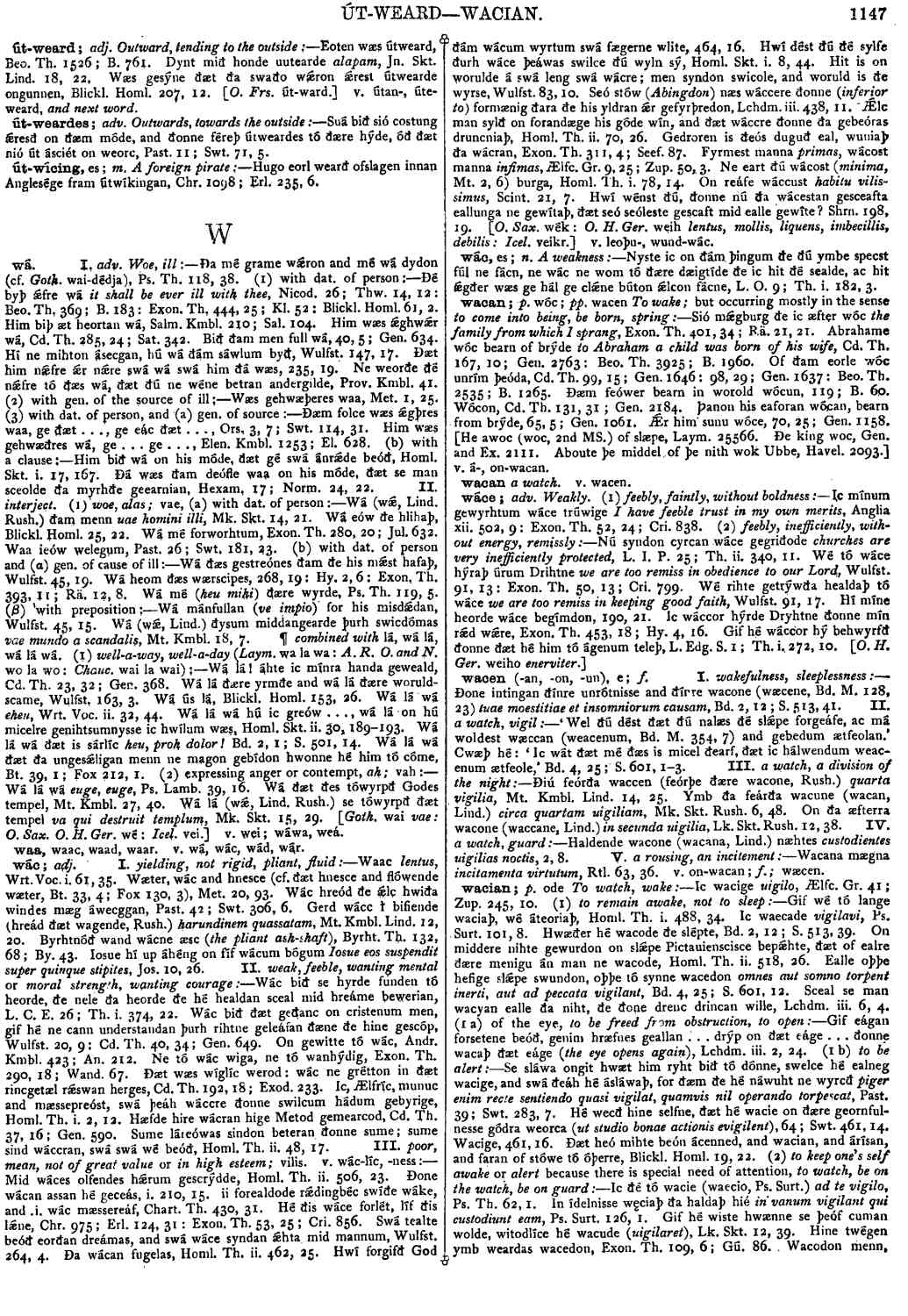
wáce
- adverb
Grammar
Weakly.
feebly, faintly, without boldness
-
Ic mínum gewyrhtum wáce trúwige
I have feeble trust in my own merits,
- Anglia xii. 502, 9: Exon. Th. 52, 24 ;
- Cri. 838.
feebly, inefficiently, without energy, remissly
-
Nú syndon cyrcan wáce gegriðode
churches are very inefficiently protected,
- L. I. P. 25 ;
- Th. ii. 340, 11.
-
Wé tó wáce hýraþ úrum Drihtne
we are too remiss in obedience to our Lord,
- Wulfst. 91, 13: Exon. Th. 50, 13 ;
- Cri. 799.
-
Wé rihte getrýwða healdaþ tó wáce
we are too remiss in keeping good faith,
- Wulfst. 91, 17.
-
Hí míne heorde wáce begímdon,
- 190, 21.
-
Ic wáccor hýrde Dryhtne ðonne mín rǽd wǽre,
- Exon. Th. 453, 18 ;
- Hy. 4, 16.
-
Gif hé wáccor hý behwyrfð ðonne ðæt hé him tó ágenum teleþ,
- L. Edg. S. 1 ;
- Th. i. 272, 10.
Etymology
O. H. Ger. weiho enerviter
.]
Linked entries
v.
wác-scipe.
Entry information
Citation
Bosworth, Joseph. “wáce.” In An Anglo-Saxon Dictionary Online, edited by Thomas Northcote Toller, Christ Sean, and Ondřej Tichy. Prague: Faculty of Arts, Charles University, 2014. https://bosworthtoller.com/34184.
Checked: 2