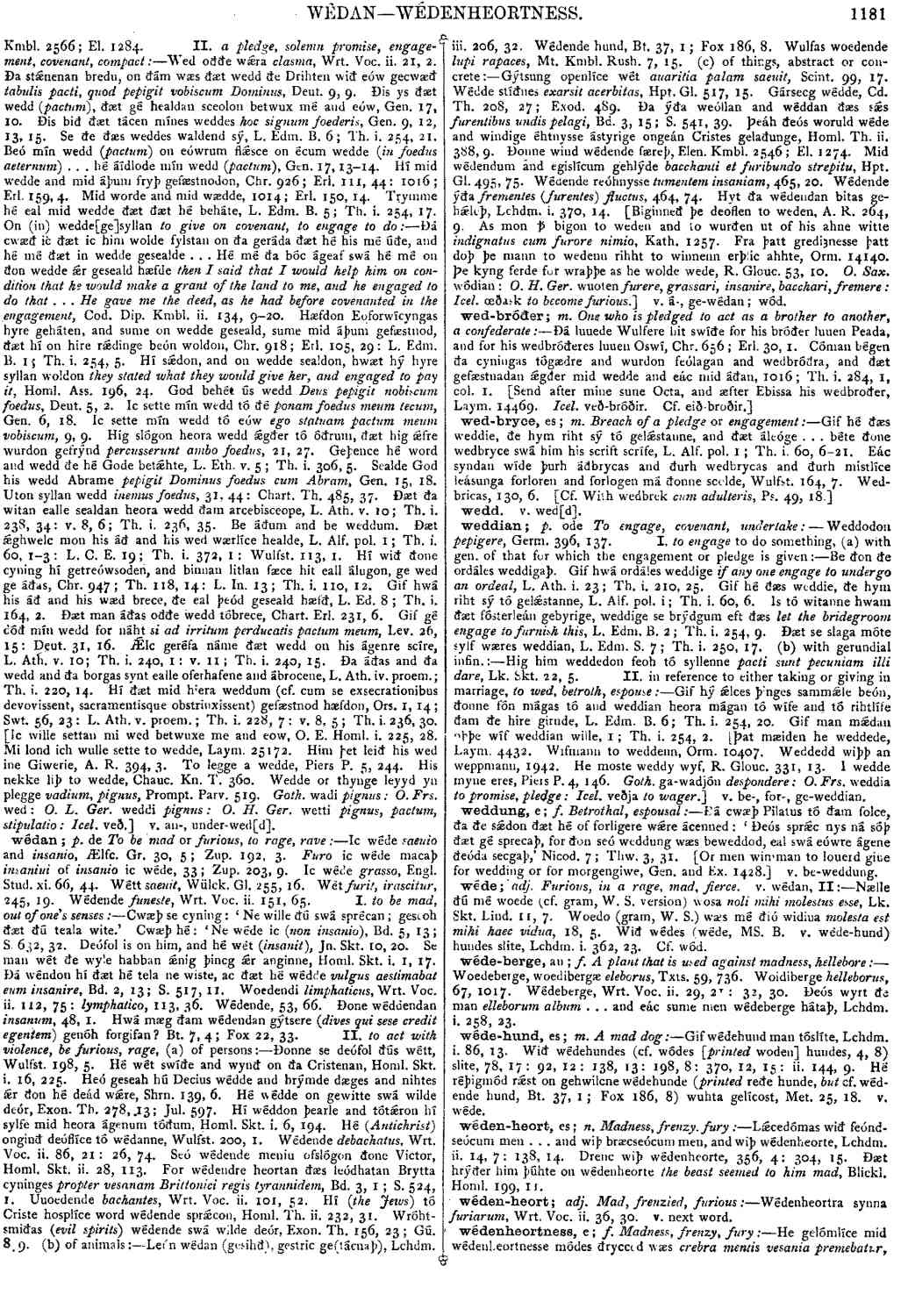
wédan
- verb [ weak ]
-
Ic wéde
saeuio and insanio,
- Ælfc. Gr. 30, 5 ;
- Zup. 192, 3.
-
Furo
ic wéde macaþ
insaniui of insanio
ic wéde,
- 33 ;
- Zup. 203, 9.
-
Ic wéde
grasso.
- Engl. Stud. xi. 66, 44.
-
Wétt
saeuit,
- Wülck. Gl. 255, 16.
-
Wét
furit, irascitur,
- 245, 19.
-
Wédende
funeste,
- Wrt. Voc. ii. 151, 65.
-
Cwæþ se cyning : ' Ne wille ðú swá sprécan ; ðæt ðú teala wite. ' Cwæþ hé: 'Ne wéde ic
(non insanio),- Bd. 5, 13 ;
- S. 632, 32.
-
Deófol is on him, and hé wét (insanit),
- Jn. Skt. 10, 20.
-
Se man wét ðe wyle habban ǽnig þincg ǽr anginne,
- Homl. Skt. i. 1. 17.
-
Ðá wéndon hí ðæt hé tela ne wiste, ac ðæt hé wédde
vulgus aestimabat eum insanire,
- Bd. 2, 13 ;
- S. 517, 11.
-
Woedendi
limphaticus
,- Wrt. Voc. ii. 112, 75
lymphatico
,- 113, 36.
-
Wédende,
- 53, 66.
-
Ðone wéddendan
insanum
,- 48, 1.
-
Hwá mæg ðam wédendan gýtsere (dives qui sese credit egentem) genóh forgifan?
- Bt. 7.4 ;
- Fox 22, 33.
-
Ðonne se deófol ðús wétt,
- Wulfst. 198, 5.
-
Hé wét swíðe and wynð on ða Cristenan,
- Homl. Skt. i. 16, 225.
-
Heó geseah hú Decius wédde and brýmde dæges and nihtes ǽr ðon hé deád wǽre,
- Shrn. 139, 6.
-
Hé wédde on gewitte swá wilde deór,
- Exon. Th. 278, 13 ;
- Jul. 597.
-
Hí wéddon þearle and tðtǽron hí sylfe mid heora ágenum tóðum,
- Homl. Skt. i. 6, 194.
-
Hé (Antichrist) onginð deóflíce tó wédanne,
- Wulfst. 200, 1.
-
Wédende
debachatus.
- Wrt. Voc. ii. 86, 21 :
- 26, 74.
-
Seó wédende men iu ofslógon ðone Victor,
- Homl. Skt. ii. 28, 113.
-
For wédendre heortan ðæs leódhatan Brytta cyninges
propter vesanam Brittonici regis tyrannidem,
- Bd. 3, 1 ;
- S. 524, 1.
-
Uuoedende
bachantes,
- Wrt. Voc. ii. 101, 52.
-
Hí the Jews tó Criste hosplíce word wédende sprǽcon,
- Homl. Th. ii. 232, 31.
-
Wróht*-*smiðas (evil spirits) wédende swá wilde deór,
- Exon. Th. 156, 23 ;
- Gú. 8, 9.
-
wédan (gesihð), gestric ge(tácnaþ),
- Lchdm. iii. 206, 32.
-
Wédende hund,
- Bt. 37, 1 ;
- Fox 186, 8.
-
Wulfas woedende
lupi rapaces,
- Mt. Kmbl. Rush. 7, 15.
-
Gýtsung openlíce wét
auaritia palam saenit,
- Scint. 99, 17.
-
Wédde stíðnes
exarsit acerbitas,
- Hpt. Gl. 517, 15.
-
Gársecg wédde,
- Cd. Th. 208, 27 ;
- Exod. 489 .
-
Ða ýða weóllan and wéddan ðæs sǽs
furentibus undis pelagi,
- Bd. 3, 15 ;
- S. 541, 39.
-
Þeán ðeós woruld wéde and windige éhtnysse ástyrige ongeán Cristes gelaðunge,
- Homl. Th. ii. 388, 9.
-
Ðonne wind wédende færeþ,
- Elen. Kmbl. 2546 ;
- El. 1274.
-
Mid wédendum and egislícum gehlýde
bacchanti et furibundo strepitu,
- Hpt. Gl. 495, 75.
-
Wédende reóhnysse
tumentem insaniam,
- 465, 20.
-
Wédende ýða
frementes (furentes) fluctus,
- 464, 74.
-
Hyt ða wédendan bitas ge*-*hǽlcþ,
- Lchdm. i. 370, 14.
-
[
Biginneð þe deoflen to weden,
- A. R. 264, 9.
-
As mon bigon to weden and to wurðen ut of his ahne witte indignatns cum.
furore nimio,
- Kath. 1257.
-
Fra þatt grediȝnesse þatt doþ þe mann to wedenu rihht to winnenn erþlic ahhte,
- Orm. 14140.
-
Þe kyng ferde for wraþþe as he wolde wede,
- R. Glouc. 53, 10.
Bosworth, Joseph. “wédan.” In An Anglo-Saxon Dictionary Online, edited by Thomas Northcote Toller, Christ Sean, and Ondřej Tichy. Prague: Faculty of Arts, Charles University, 2014. https://bosworthtoller.com/34927.
Checked: 1