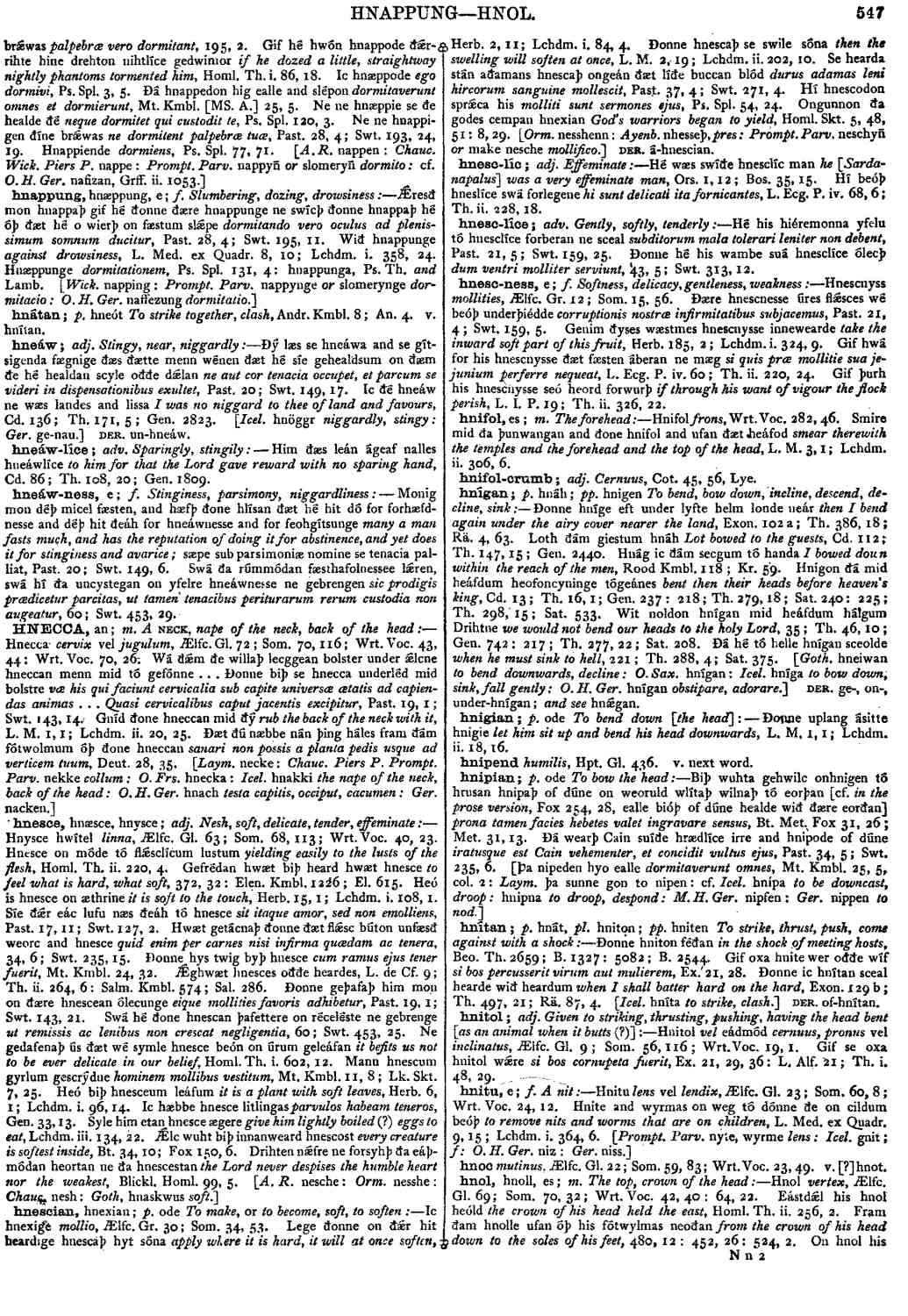
hnígan
- verb [ strong ]
Grammar
Wright's OE grammar
§325;
§490;
To bend, bow down, incline, descend, decline, sink
-
Ðonne hníge eft under lyfte helm londe neár
then I bend again under the airy cover nearer the land,
- Exon. 102 a;
- Th. 386, 18;
- Rä. 4, 63.
-
Loth ðám giestum hnáh
Lot bowed to the guests,
- Cd. 112;
- Th. 147, 15;
- Gen. 2440.
-
Hnág ic ðám secgum tó handa
I bowed down within the reach of the men,
- Rood Kmbl. 118;
- Kr. 59.
-
Hnígon ðá mid heáfdum heofoncyninge tógeánes
bent then their heads before heaven's king,
- Cd. 13;
- Th. 16, 1;
- Gen. 237: 218;
- Th. 279, 18;
- Sat. 240: 225;
- Th. 298, 15;
- Sat. 533.
-
Wit noldon hnígan mid heáfdum hálgum Drihtne
we would not bend our heads to the holy Lord,
- 35;
- Th. 46, 10;
- Gen. 742: 217;
- Th. 277, 22;
- Sat. 208.
-
Ðá hé tó helle hnígan sceolde
when he must sink to hell,
- 221;
- Th. 288, 4;
- Sat. 375.
Etymology
[Goth. hneiwan to bend downwards, decline:
O. Sax. hnígan:
Icel. hníga to bow down, sink, fall gently;
O. H. Ger. hnígan obstipare, adorare.]
Derived forms
Linked entries
v.
ge-hnígan.
Entry information
Citation
Bosworth, Joseph. “hnígan.” In An Anglo-Saxon Dictionary Online, edited by Thomas Northcote Toller, Christ Sean, and Ondřej Tichy. Prague: Faculty of Arts, Charles University, 2014. https://bosworthtoller.com/19369.
Checked: 2