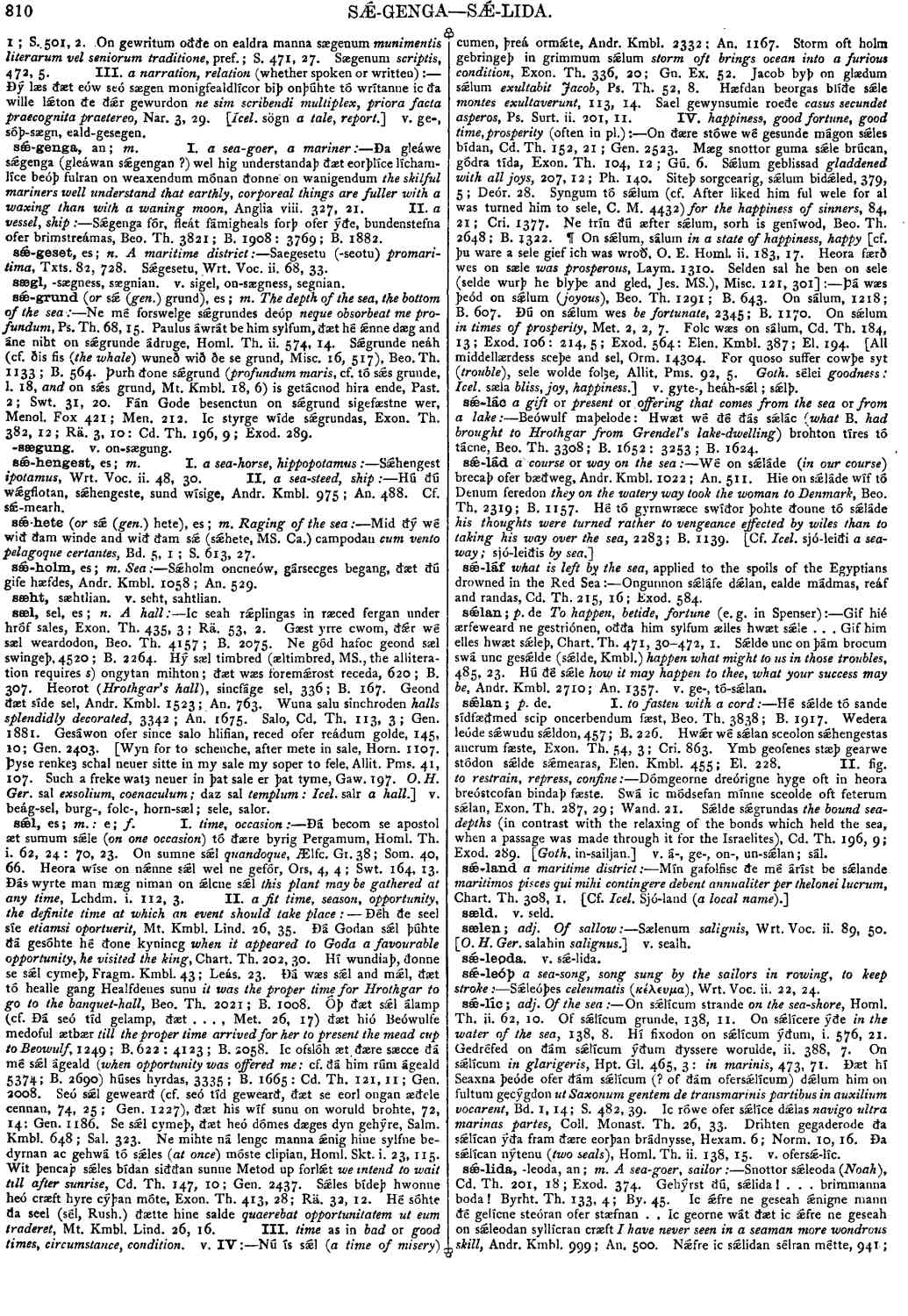
sǽl
- noun [ masculinefeminine ]
-
Ðá becom se apostol æt sumum sǽle (on one occasion ) tó ðære byrig
- Pergamum, Homl. Th. i. 62, 24: 70, 23 .
-
On sumne sǽl
quandoque,
- Ælfc. Gr. 38 ;
- Som. 40, 66 .
-
Heora wíse on nǽnne sǽl wel ne gefór,
- Ors. 4, 4 ;
- Swt. 164, 13 .
-
Ðás wyrte man mæg niman on ǽlcne sǽl
this plant may be gathered at any time,
- Lchdm. i. 112, 3 .
-
Ðéh ðe seel síe
etiamsi oportuerit,
- Mt. Kmbl. Lind. 26, 35 .
-
Ðá Godan sǽl þúhte ðá gesóhte hé ðone kynincg
when it appeared to Goda a favourable opportunity, he visited the king,
- Chart. Th. 202, 30 .
-
Hí wundiaþ, ðonne se sǽl cymeþ,
- Fragm. Kmbl. 43 ;
- Leás. 23 .
-
Ðá wæs sǽl and mǽl, ðæt tó healle gang Healfdenes sunu
it was the proper time for Hrothgar to go to the banquet-hall,
- Beo. Th. 2021 ;
- B. 1008 .
-
Óþ ðæt sǽl álamp (cf. Ðá seó tíd gelamp, ðæt . . . , Met. 26, 17) ðæt hió Beówulfe medoful ætbær
till the proper time arrived for her to present the mead cup to Beowulf,
- 1249 ;
- B. 622: 4123 ;
- B. 2058 .
-
Ic ofslóh æt ðære sæcce ðá mé sǽl ágeald ( when opportunity was offered me: cf. ðá him rúm ágeald 5374; B. 2690)húses hyrdas,
- 3335 ;
- B. 1665: Cd. Th. 121, 11 ;
- Gen. 2008 .
-
Seó sǽl gewearð (cf. seó tíd gewearð, ðæt se eorl ongan æðele cennan, 74, 25;Gen. 1227), ðæt his wíf sunu on woruld brohte,
- 72, 14: Gen. 1186.
-
Se sǽl cymeþ, ðæt heó dómes dæges dyn gehýre,
- Salm. Kmbl. 648 ;
- Sal. 323 .
-
Ne mihte ná lengc manna ǽnig hine sylfne bedyrnan ac gehwá tó sǽles ( at once ) móste clipian,
- Homl. Skt. i. 23, 115 .
-
Wit þencaþ sǽles bídan siððan sunne Metod up forlǽt
we intend to wait till after sunrise,
- Cd. Th. 147, 10 ;
- Gen. 2437 .
-
Sǽles bídeþ hwonne heó cræft hyre cýþan móte,
- Exon. Th. 413, 28 ;
- Rä. 32, 12 .
-
Hé sóhte ða seel (sél, Rush.) ðætte hine salde
quaerebat opportunitatem ut eum traderet,
- Mt. Kmbl. Lind. 26, 16 .
-
Nú íssǽl (a time of misery ) cumen, þreá ormǽte,
- Andr. Kmbl. 2332: An. 1167 .
-
Storm oft holm gebringeþ in grimmum sǽlum
storm oft brings ocean into a furious condition,
- Exon. Th. 336, 20 ;
- Gn. Ex. 52 .
-
Jacob byþ on glædum sǽlum
exultabit Jacob,
- Ps. Th. 52, 8 .
-
Hæfdan beorgas blíðe sǽle
montes exultaverunt,
- 113, 14 .
-
Sael gewynsumie roeðe
casus secundet asperos,
- Ps. Surt. ii. 201, 11 .
-
On ðære stówe wé gesunde mágon sǽles bídan,
- Cd. Th. 152, 21 ;
- Gen. 2523 .
-
Mæg snottor guma sǽle brúcan, gódra tída,
- Exon. Th. 104, 12 ;
- Gú. 6 .
-
Sǽlum geblissad
gladdened with all joys,
- 207, 12 ;
- Ph. 140 .
-
Siteþ sorgcearig, sǽlum bidǽled,
- 379, 5 ;
- Deór. 28 .
-
Syngum tó sǽlum (cf. After liked him ful wele for al was turned him to sele, C. M. 4432)
for the happiness of sinners,
- 84, 21 ;
- Cri. 1377 .
-
Ne frín ðú æfter sǽlum, sorh is geníwod,
- Beo. Th. 2648 ;
- B. 1322 .
- 
On sǽlum, sálum
in a state of happiness, happy
- [cf.
þu ware a sele gief ich was wroð,
- O. E. Homl. ii. 183, 17 .
-
Heora færð wes on sæle
was prosperous,
- Laym. 1310 .
-
Selden sal he ben on iele (selde wurþ he blyþe and gled, Jes. MS.)
,- Misc. 121, 301
- :--
Þá wæs þeód on sǽlum
(joyous
),- Beo. Th. 1291 ;
- B. 643 .
-
On sálum,
- 1218 ;
- B. 607 .
-
Ðú on sǽlum wes
be fortunate,
- 2345 ;
- B. 1170 .
-
On sǽlum
in times of prosperity,
- Met. 2, 2, 7 .
-
Folc wæs on sálum,
- Cd. Th. 184, 13 ;
- Exod. 106: 214, 5 ;
- Exod. 564: Elen. Kmbl. 387 ;
- El. 194 .
All middellærdess sceþe and sel,
- Orm. 14304.
For quoso suffer cowþe syt (trouble), sele wolde folȝe,
- Allit. Pms. 92, 5.
Bosworth, Joseph. “sǽl.” In An Anglo-Saxon Dictionary Online, edited by Thomas Northcote Toller, Christ Sean, and Ondřej Tichy. Prague: Faculty of Arts, Charles University, 2014. https://bosworthtoller.com/26212.
Checked: 2