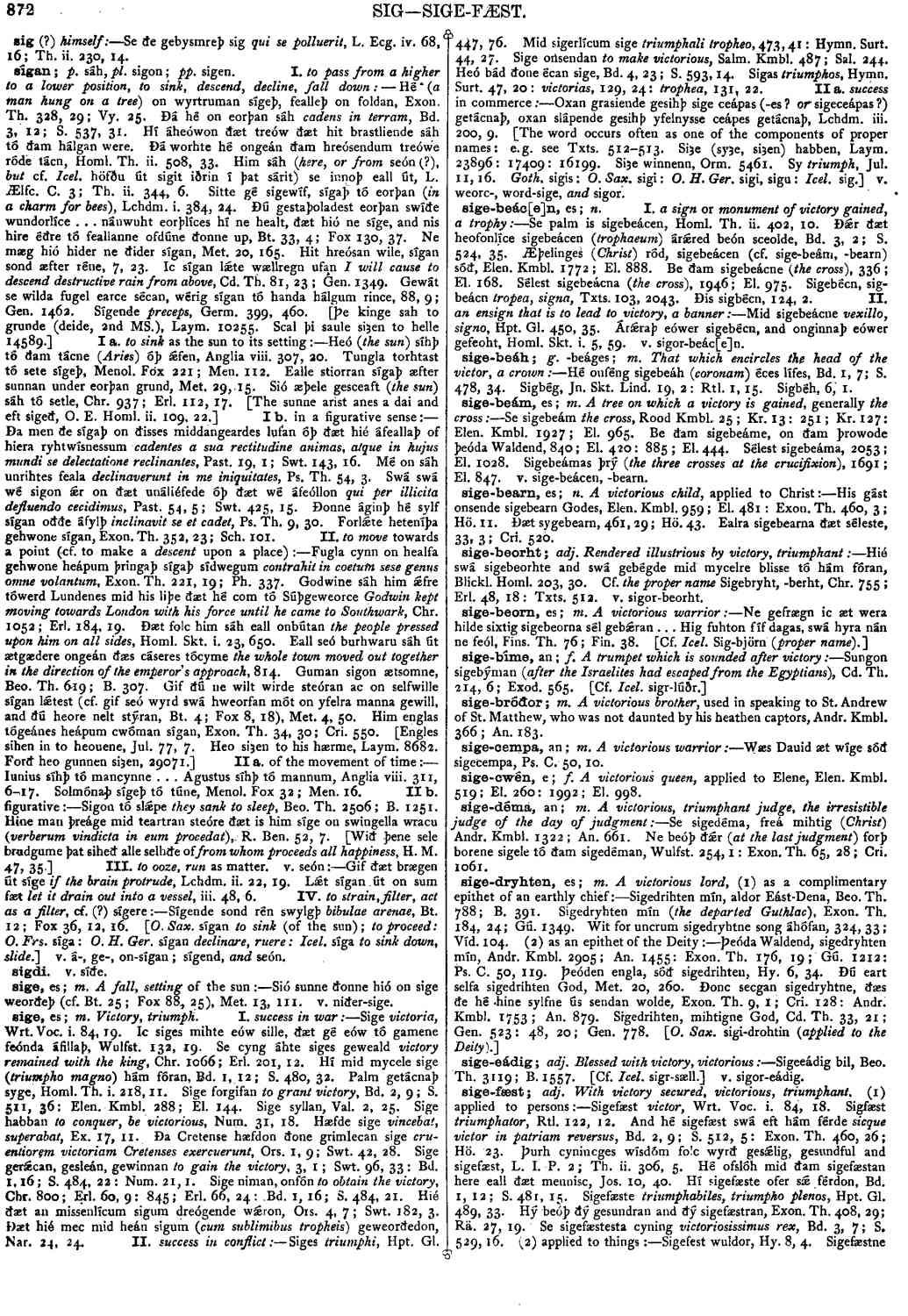
sígan
- verb [ strong ]
-
Hé (a man hung on a tree) on wyrtruman sígeþ, fealleþ on foldan,
- Exon. Th. 328, 29 ;
- Vy. 25 .
-
Ðá hé on eorþan sáh
cadens in terram,
- Bd. 3, 12 ;
- S. 537, 31 .
-
Hí áheówon ðæt treów ðæt hit brastliende sáh tó ðam hálgan were. Ðá worhte hé ongeán ðam hreósendum treówe róde tácn,
- Homl. Th. ii. 508, 33 .
-
Him sáh (here, or from seón (?), but cf.
- L. Ælfc. C. 3 ;
- Th. ii. 344, 6 .
-
Sitte gé sigewíf, sígaþ tó eorþan
(in a charm for bees),- Lchdm. i. 384, 24 .
-
Ðú gestaþoladest eorþan swíðe wundorlíce . . . nánwuht eorþlíces hí ne healt, ðæt hió ne síge, and nis hire éðre tó feallanne ofdúne ðonne up,
- Bt. 33, 4 ;
- Fox 130, 37 .
-
Ne mæg hió hider ne ðider sígan,
- Met. 20, 165 .
-
Hit hreósan wile, sígan sond æfter réne,
- 7, 23 .
-
Ic sígan lǽte wællregn ufan
I will cause to descend destructive rain from above,
- Cd. Th. 81, 23 ;
- Gen. 1349 .
-
Gewát se wilda fugel earce sécan, wérig sígan tó handa hálgum rince,
- 88, 9 ;
- Gen. 1462 .
-
Sígende
preceps,
- Germ. 399, 460 .
-
Heó (the sun) síhþ tó ðam tácne (Aries) óþ ǽfen,
- Anglia viii. 307, 20 .
-
Tungla torhtast tó sete sígeþ,
- Menol. Fox 221 ;
- Men. 112 .
-
Ealle stiorran sígaþ æfter sunnan under eorþan grund,
- Met. 29, 15 .
-
Sió æþele gesceaft (the sun) sáh tó setle,
- Chr. 937 ;
- Erl. 112, 17 .
-
Ða men ðe sígaþ on ðisses middangeardes lufan óþ ðæt hié áfeallaþ of hiera ryhtwísnessum
cadentes a sua rectitudine animas, atque in hujus mundi se delectatione reclinantes,
- Past. 19, 1 ;
- Swt. 143, 16 .
-
Mé on sáh unrihtes feala
declinaverunt in me iniquitates,
- Ps. Th. 54, 3 .
-
Swá swá wé sigon ǽr on ðæt unáliéfede óþ ðæt wé áfeóllon
qui per illicita defluendo cecidimus,
- Past. 54, 5 ;
- Swt. 425, 15 .
-
Ðonne áginþ hé sylf sígan oððe áfylþ
inclinavit se et cadet,
- Ps. Th. 9, 30 .
-
Forlǽte heteníþa gehwone sígan,
- Exon. Th. 352, 23 ;
- Sch. 101 .
-
Fugla cynn on healfa gehwone heápum þringaþ sígaþ sídwegum
contrahit in coetum sese genus omne volantum,
- Exon. Th. 221, 19 ;
- Ph. 337 .
-
Godwine sáh him ǽfre tówerd Lundenes mid his liþe ðæt hé com tó Súþgeweorce
Godwin kept moving towards London with his force until he came to Southwark,
- Chr. 1052 ;
- Erl. 184, 19 .
-
Ðæt folc him sáh eall onbútan
the people pressed upon him on all sides,
- Homl. Skt. i. 23, 650 .
-
Eall seó burhwaru sáh út ætgædere ongeán ðæs cáseres tócyme
the whole town moved out together in the direction of the emperor's approach,
- 814 .
-
Guman sigon ætsomne.
- Beo. Th. 619 ;
- B. 307 .
-
Gif ðú ne wilt wirde steóran ac on selfwille sígan lǽtest
(cf. gif seó wyrd swá hweorfan mót on yfelra manna gewill, and ðú heore nelt stýran, Bt. 4 ; Fox 8, 18),- Met. 4, 50 .
-
Him englas tógeánes heápum cwóman sígan,
- Exon. Th. 34, 30 ;
- Cri. 550 .
-
Iunius síhþ tó mancynne . . . Agustus síhþ tó mannum,
- Anglia viii. 311, 6-17 .
-
Solmónaþ sígeþ tó túne,
- Menol. Fox 32 ;
- Men. 16 .
-
Sigon tó slǽpe
they sank to sleep,
- Beo. Th. 2506 ;
- B. 1251 .
-
Hine man þreáge mid teartran steóre ðæt is him síge on swingella wracu
(verberum vindicta in eum procedat),
- R. Ben. 52, 7 .
-
Gif ðæt brægen út síge
if the brain protrude,
- Lchdm. ii. 22, 19 .
-
Lǽt sígan út on sum fæt
let it drain out into a vessel,
- iii. 48, 6 .
-
Sígende sond rén swylgþ
bibulae arenae,
- Bt. 12 ;
- Fox 36, 12, 16 .
Bosworth, Joseph. “sígan.” In An Anglo-Saxon Dictionary Online, edited by Thomas Northcote Toller, Christ Sean, and Ondřej Tichy. Prague: Faculty of Arts, Charles University, 2014. https://bosworthtoller.com/27662.
Checked: 2