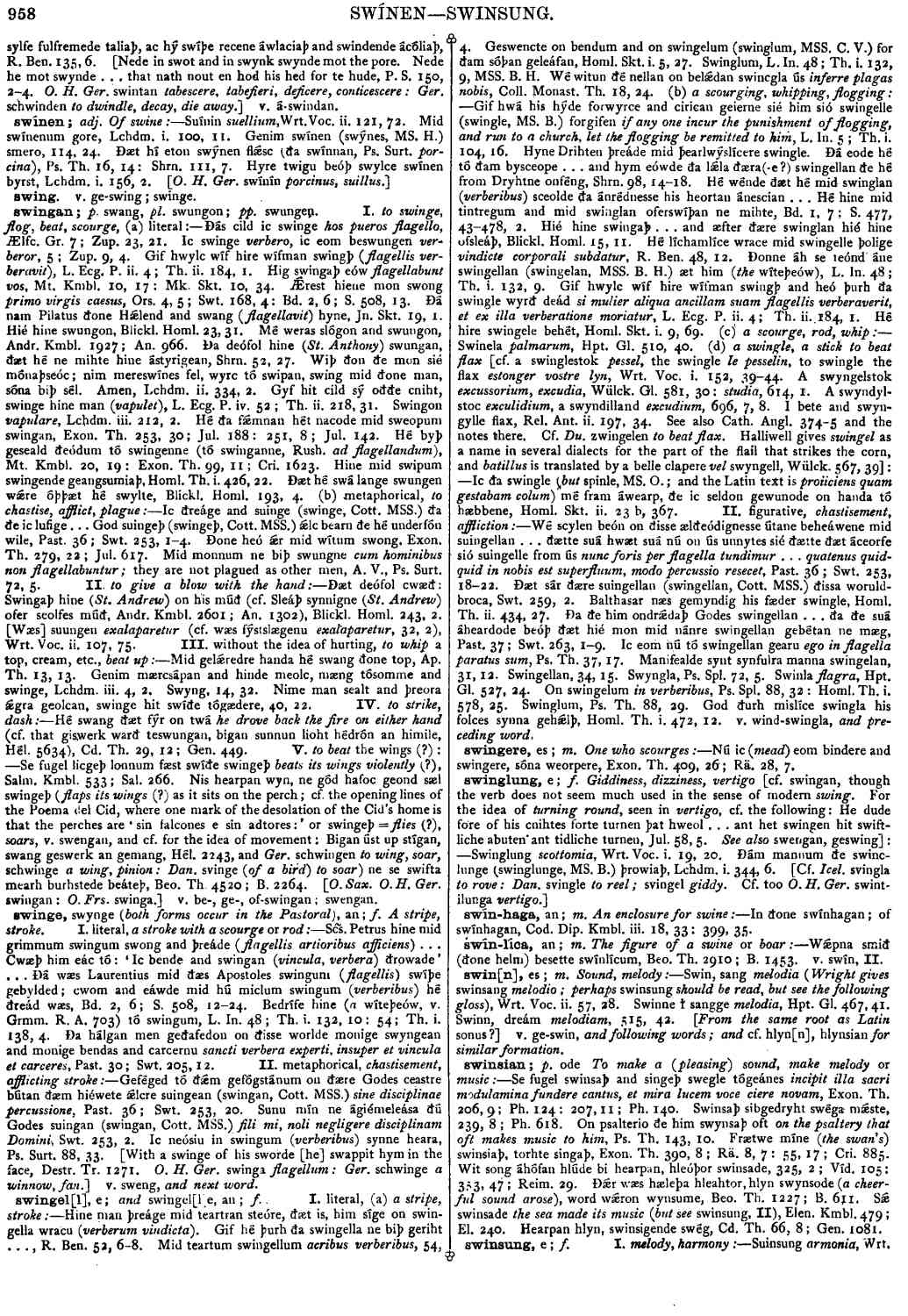
swingan
- verb [ strong ]
-
Ðás cild ic swinge
hos pueros flagello,
- Ælfc. Gr. 7, Zup. 23, 21.
-
Ic swinge
verbero
,ic eom beswungen
ver*-*beror,
- 5 ; Zup. 9, 4.
-
Gif hwylc wíf hire wífman swingþ
(flagellis verberavit)
,- L. Ecg. P. ii. 4 ;
- Th. ii. 184, I.
Hig swingaþ eów
flagellabunt vos.
- Mt. Kmbl. 10, 17: Mk. Skt. 10, 34.
-
Ǽrest hiene mon swong
primo virgis caesus,
- Ors. 4, 5 ;
- Swt. 168, 4: Bd. 2, 6 ;
- S. 508, 13.
-
Ða nam Pilatus ðone Hǽlend and swang (flagellavit) hyne.
- Jn. Skt. 19, 1.
-
Hié hine swungon.
- Blickl. Homl. 23, 31.
-
Mé weras slógon and swungon,
- Andr. Kmbl. 1927 ;
- An. 966.
-
Ða deófol hine ( St. Anthony) swungan, ð æt hé ne mihte hine ástyrigean,
- Shrn. 52, 27.
-
Wiþ ðon ðe mon sié mónaþseóc; nim mereswínes fel, wyrc tó swipan, swing mid ðone man, sóna biþ sél. Amen,
- Lchdm. ii. 334, 2.
-
Gyf hit cild sý oððe cniht, swinge hine man
(vapulet),
- L. Ecg. P. iv. 52 ;
- Th. ii. 218, 31.
-
Swingon
vapulare
,- Lchdm. iii. 212, 2.
-
He ða fǽmnan hét nacode mid sweopum swingan,
- Exon. Th. 253, 30 ;
- Jul. 188: 251, 8 ;
- Jul. 142.
-
Hé byþ geseald ðeódum tó swingenne (tó swinganne
,- Rush.
ad flagellandum
),- Mt. Kmbl. 20, 19: Exon. Th. 99, ii ;
- Cri. 1623.
-
Hine mid swipum swingende geangsumiaþ.
- Homl. Th. i. 426, 22.
-
Ðæt hé swá lange swungen wǽre óþþæt hé swylte.
- Blickl. Homl. 193, 4.
-
Ic ðreáge and suinge (swinge, Cote. MSS. ) ða ðe ic lufige , . . God suingeþ (swingeþ, Cole. MSS. ) ǽlc bearn ðe hé underfón wile,
- Past. 36 ;
- Swt. 253, 1-4.
-
Ðone heó ǽr mid wítum swong.
- Exon. Th. 279, 22 ;
- Jul. 617.
-
Mid monnum ne biþ swungne
cum hominibus non flagellabuntur;
they are not plagued as other men,
- A. V. , Ps. Surt. 72, 5.
-
Ðæt deófol cwæð: Swingaþ hine (St. Andrew) on his múð (cf. Sleáþ synnigne St. Andrew ofer seolfes múð,
- Andr. Kmbl. 2601 ;
- An. 1302
- Blickl. Homl. 243, 2.
[Wæs] suungen
exalaparetur
(cf. wæs fýstslægenu exalaparetur, 32, 2),- Wrt. Voc. ii. 107, 75.
-
Mid gelǽredre handa hé swang ðone top,
- Ap. Th. 13, 13.
-
Genim mærcsápan and hinde meolc, mæng tósomme and swinge,
- Lchdm. iii. 4, 2.
-
Swyng,
- 14, 32.
-
Nime man sealt and þreora ǽgra geolcan, swinge hit swiðe tógædere,
- 40, 22.
-
Hé swang ðæt fýr on twá
he drove back the fire on either hand
(cf. that giswerk warð teswungan, bigan sunnun lioht hédrón an himile, Hél. 5634),- Cd. Th. 29, 12 ;
- Gen. 449.
-
Se fugel licgeþ lonnum fæst swíðe swingeþ
beats its wings violently (?),
- Salm. Kmbl. 533 ;
- Sal. 266.
-
Nis hearpan wyn, ne gód hafoc geond sæl swingeþ (flaps its wings as it sits on the perch; cf. the opening lines of the Poema del Cid, where one mark of the desolation of the Cid's home is that the perches are ' sin falcones e sin adtores:' or swingeþ = flies, soars, v. swengan, and cf. for the idea of movement; Bigan úst up stígan, swang geswerk an gemang, Hél. 2243, and
- Beo. Th 4520 ;
- B. 2264.
Bosworth, Joseph. “swingan.” In An Anglo-Saxon Dictionary Online, edited by Thomas Northcote Toller, Christ Sean, and Ondřej Tichy. Prague: Faculty of Arts, Charles University, 2014. https://bosworthtoller.com/29827.
Checked: 2