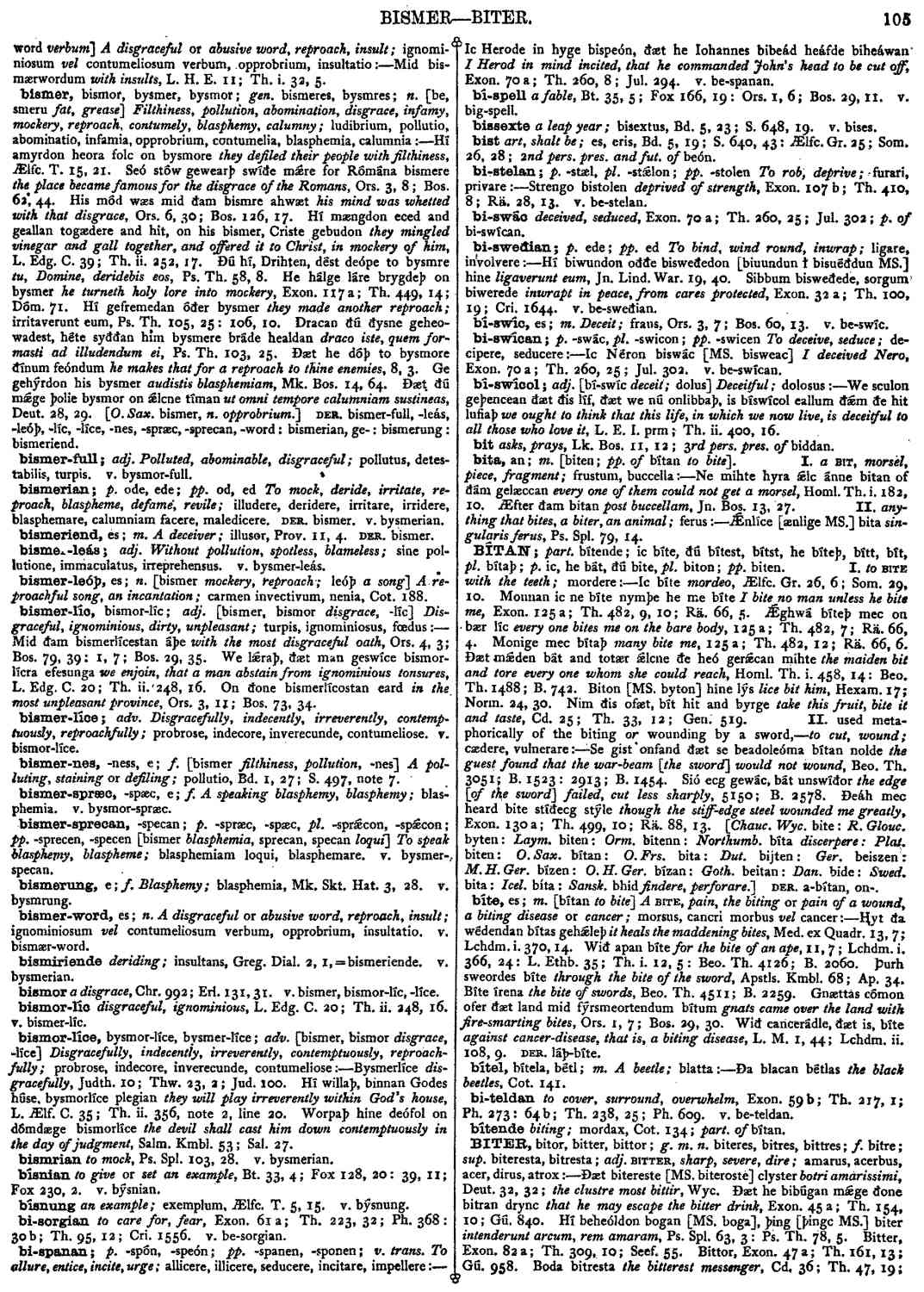
BÍTAN
- verb [ strong ]
-
Ic bíte
mordeo,
- Ælfc. Gr. 26, 6 ;
- Som. 29, 10 .
-
Monnan ic ne bíte nymþe he me bíte
I bite no man unless he bite me,
- Exon. 125 a ;
- Th. 482, 9, 10 ;
- Rä. 66, 5 .
-
Ǽghwá bíteþ mec on bær líc
every one bites me on the bare body,
- 125 a ;
- Th. 482, 7 ;
- Rä. 66, 4 .
-
Monige mec bítaþ
many bite me,
- 125 a ;
- Th. 482, 12 ;
- Rä. 66, 6 .
-
Ðæt mǽden bát and totær ǽlcne ðe heó gerǽcan mihte
the maiden bit and tore every one whom she could reach,
- Homl. Th. i. 458, 14 :
- Beo. Th. 1488 ;
- B. 742 .
-
Biton [MS. byton] hine lýs
lice bit him,
- Hexam. 17 ;
- Norm. 24, 30 .
-
Nim ðis ofæt, bít hit and byrge
take this fruit, bite it and taste,
- Cd. 25 ;
- Th. 33, 12 ;
- Gen. 519 .
-
Se gist onfand ðæt se beadoleóma bítan nolde
the guest found that the war-beam [the sword] would not wound,
- Beo. Th. 3051 ;
- B. 1523 :
- 2913 ;
- B. 1454 .
-
Sió ecg gewác, bát unswíðor
the edge [of the sword] failed, cut less sharply,
- 5150 ;
- B. 2578 .
-
Ðeáh mec heard bite stíðecg stýle
though the stiff-edge steel wounded me greatly,
- Exon. 130 a ;
- Th. 499, 10 ;
- Rä. 88, 13 .
Bosworth, Joseph. “BÍTAN.” In An Anglo-Saxon Dictionary Online, edited by Thomas Northcote Toller, Christ Sean, and Ondřej Tichy. Prague: Faculty of Arts, Charles University, 2014. https://bosworthtoller.com/4510.
Checked: 1