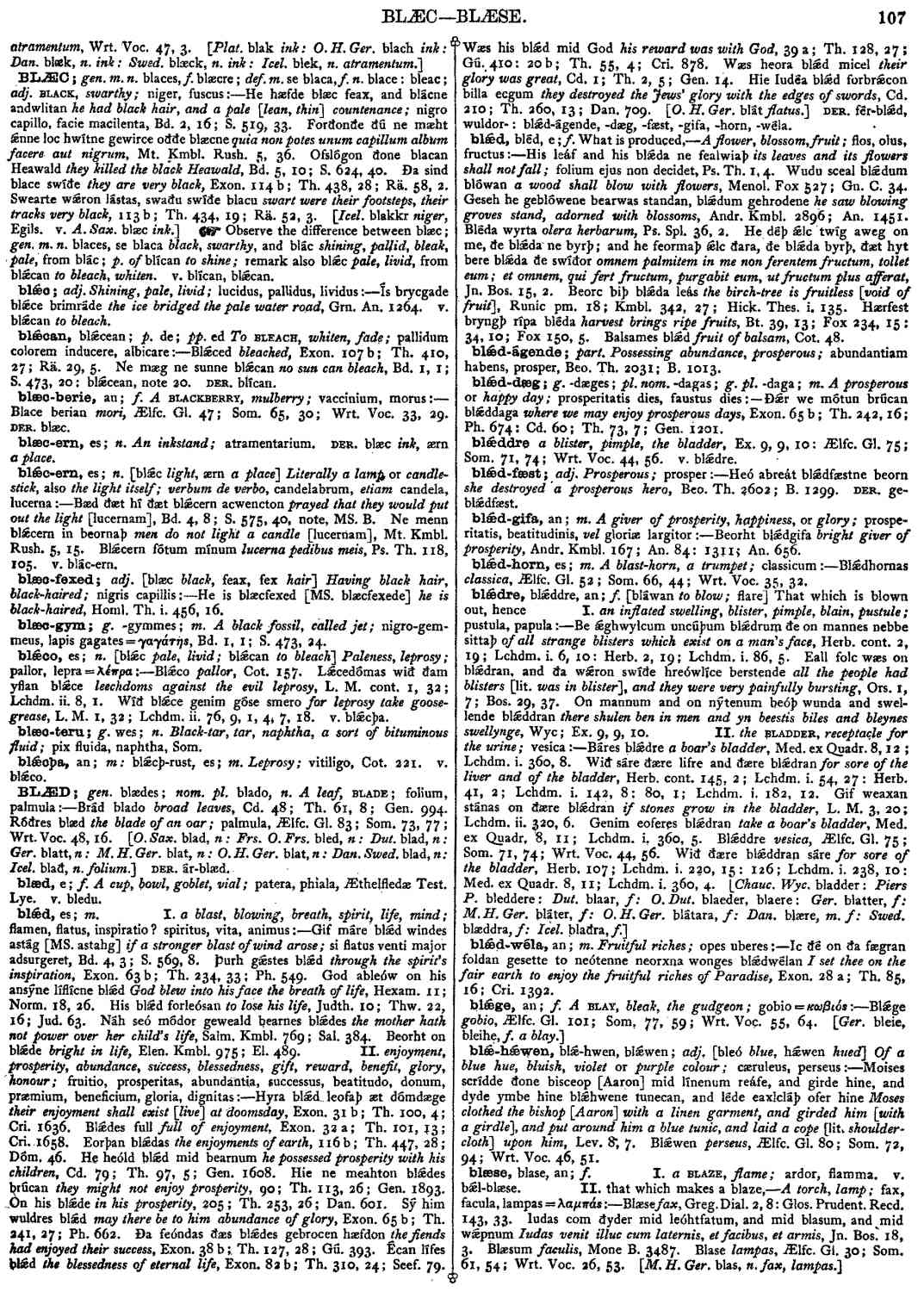
blǽd
- noun [ masculine ]
-
Gif máre blǽd windes astág [MS. astahg]
if a stronger blast of wind arose;
si flatus venti major adsurgeret,
- Bd. 4, 3 ;
- S. 569, 8 .
-
Þurh gǽstes blǽd
through the spirit's inspiration,
- Exon. 63 b ;
- Th. 234, 33 ;
- Ph. 549 .
-
God ableów on his ansýne líflícne blǽd
God blew into his face the breath of life,
- Hexam. 11 ;
- Norm. 18, 26 .
-
His blǽd forleósan
to lose his life,
- Judth. 10 ;
- Thw. 22, 16 ;
- Jud. 63 .
-
Náh seó módor geweald bearnes blǽdes
the mother hath not power over her child's life,
- Salm. Kmbl. 769 ;
- Sal. 384 .
-
Beorht on blǽde
bright in life,
- Elen. Kmbl. 975 ;
- El. 489 .
-
Hyra blǽd leofaþ æt dómdæge
their enjoyment shall exist [live] at doomsday,
- Exon. 31 b ;
- Th. 100, 4 ;
- Cri. 1636 .
-
Blǽdes full
full of enjoyment,
- Exon. 32 a ;
- Th. 101, 13 ;
- Cri. 1658 .
-
Eorþan blǽdas
the enjoyments of earth,
- 116 b ;
- Th. 447, 28 ;
- Dóm. 46.
-
He heóld blǽd mid bearnum
he possessed prosperity with his children,
- Cd. 79 ;
- Th. 97, 5 ;
- Gen. 1608 .
-
Hie ne meahton blǽdes brúcan
they might not enjoy prosperity,
- 90 ;
- Th. 113, 26 ;
- Gen. 1893 .
-
On his blǽde
in his prosperity,
- 205 ;
- Th. 253, 26 ;
- Dan. 601 .
-
Sý him wuldres blǽd
may there be to him abundance of glory,
- Exon. 65 b ;
- Th. 241, 27 ;
- Ph. 662 .
-
Ða feóndas ðæs blǽdes gebrocen hæfdon
the fiends had enjoyed their success,
- Exon. 38 b ;
- Th. 127, 28 ;
- Gú. 393 .
-
Écan lífes blǽð
the blessedness of eternal life,
- Exon. 82 b ;
- Th. 310, 24 ;
- Seef. 79 .
-
Wæs his blǽd mid God
his reward was with God,
- 39 a ;
- Th. 128, 27 ;
- Gú. 410 :
- 20 b ;
- Th. 55, 4 ;
- Cri. 878 .
-
Wæs heora blǽd micel
their glory was great,
- Cd. 1 ;
- Th. 2, 5 ;
- Gen. 14 .
-
Hie Iudéa blǽd forbrǽcon billa ecgum
they destroyed the Jews' glory with the edges of swords,
- Cd. 210 ;
- Th. 260, 13 ;
- Dan. 709 .
Bosworth, Joseph. “blǽd.” In An Anglo-Saxon Dictionary Online, edited by Thomas Northcote Toller, Christ Sean, and Ondřej Tichy. Prague: Faculty of Arts, Charles University, 2014. https://bosworthtoller.com/4583.
Checked: 1