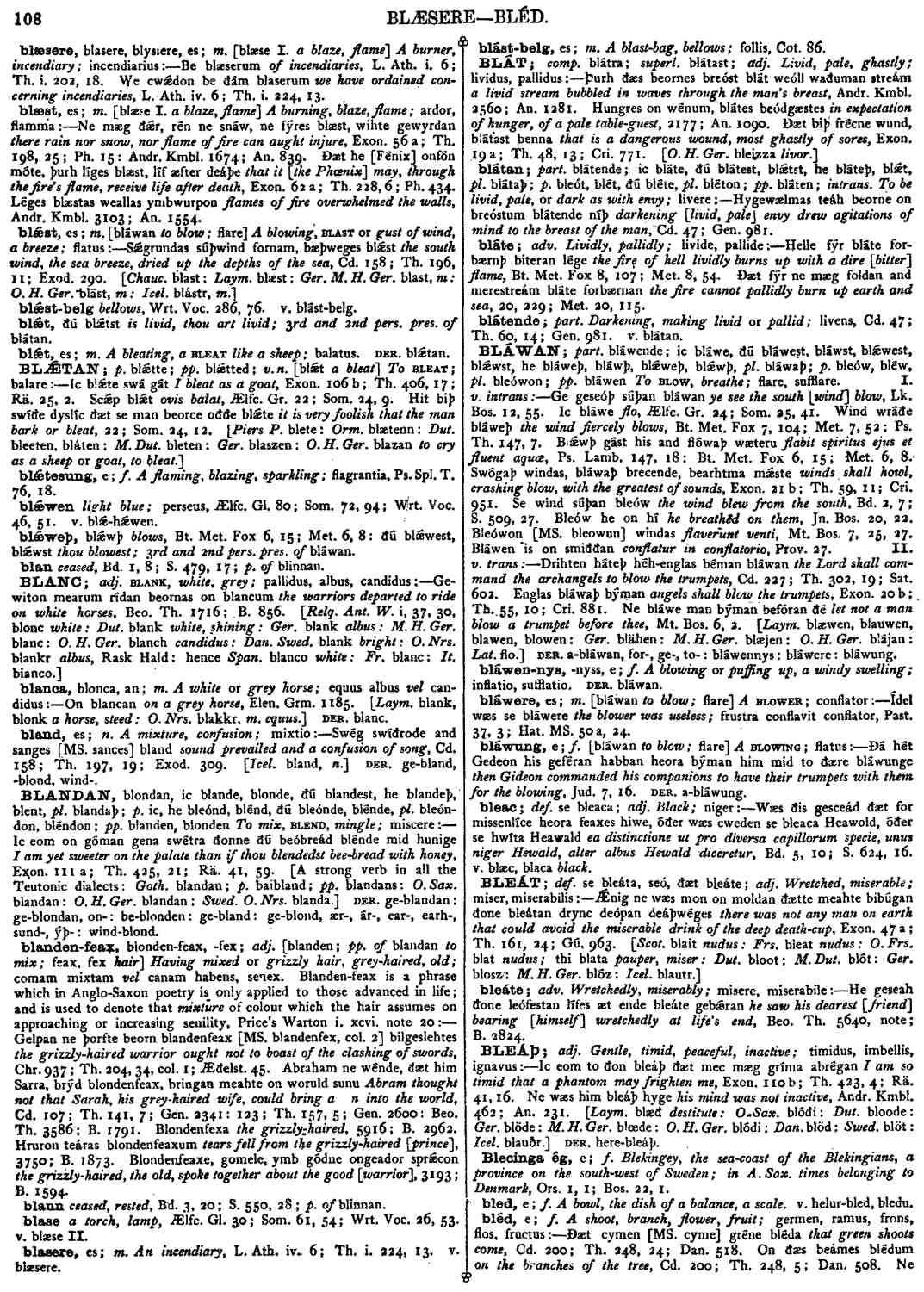
BLÁWAN
- verb [ strong ]
-
Ge geseóþ súþan bláwan
ye see the south [wind] blow,
- Lk. Bos. 12, 55 .
-
Ic bláwe
flo,
- Ælfc. Gr. 24 ;
- Som. 25, 41 .
-
Wind wráðe bláweþ
the wind fiercely blows,
- Bt. Met. Fox 7, 104 ;
- Met. 7, 52 :
- Ps. Th. 147, 7 .
-
Blǽwþ gást his and flówaþ wæteru
flabit spiritus ejus et fluent aquæ,
- Ps. Lamb. 147, 18 :
- Bt. Met. Fox 6, 15 ;
- Met. 6, 8 .
-
Swógaþ windas, bláwaþ brecende, bearhtma mǽste
winds shall howl, crashing blow, with the greatest of sounds,
- Exon. 21 b ;
- Th. 59, 11 ;
- Cri. 951 .
-
Se wind súþan bleów
the wind blew from the south,
- Bd. 2, 7 ;
- S. 509, 27 .
-
Bleów he on hí
he breathed on them,
- Jn. Bos. 20, 22 .
-
Bleówon [MS. bleowun] windas
flaverunt venti,
- Mt. Bos. 7, 25, 27 .
-
Bláwen is on smiððan
conflatur in conflatorio,
- Prov. 27 .
-
Drihten háteþ héh-englas béman bláwan
the Lord shall command the archangels to blow the trumpets,
- Cd. 227 ;
- Th. 302, 19 ;
- Sat. 602 .
-
Englas bláwaþ býman
angels shall blow the trumpets,
- Exon. 20 b ;
- Th. 55, 10 ;
- Cri. 881 .
-
Ne bláwe man býman befóran ðé
let not a man blow a trumpet before thee,
- Mt. Bos. 6, 2 .
Bosworth, Joseph. “BLÁWAN.” In An Anglo-Saxon Dictionary Online, edited by Thomas Northcote Toller, Christ Sean, and Ondřej Tichy. Prague: Faculty of Arts, Charles University, 2014. https://bosworthtoller.com/4620.
Checked: 1