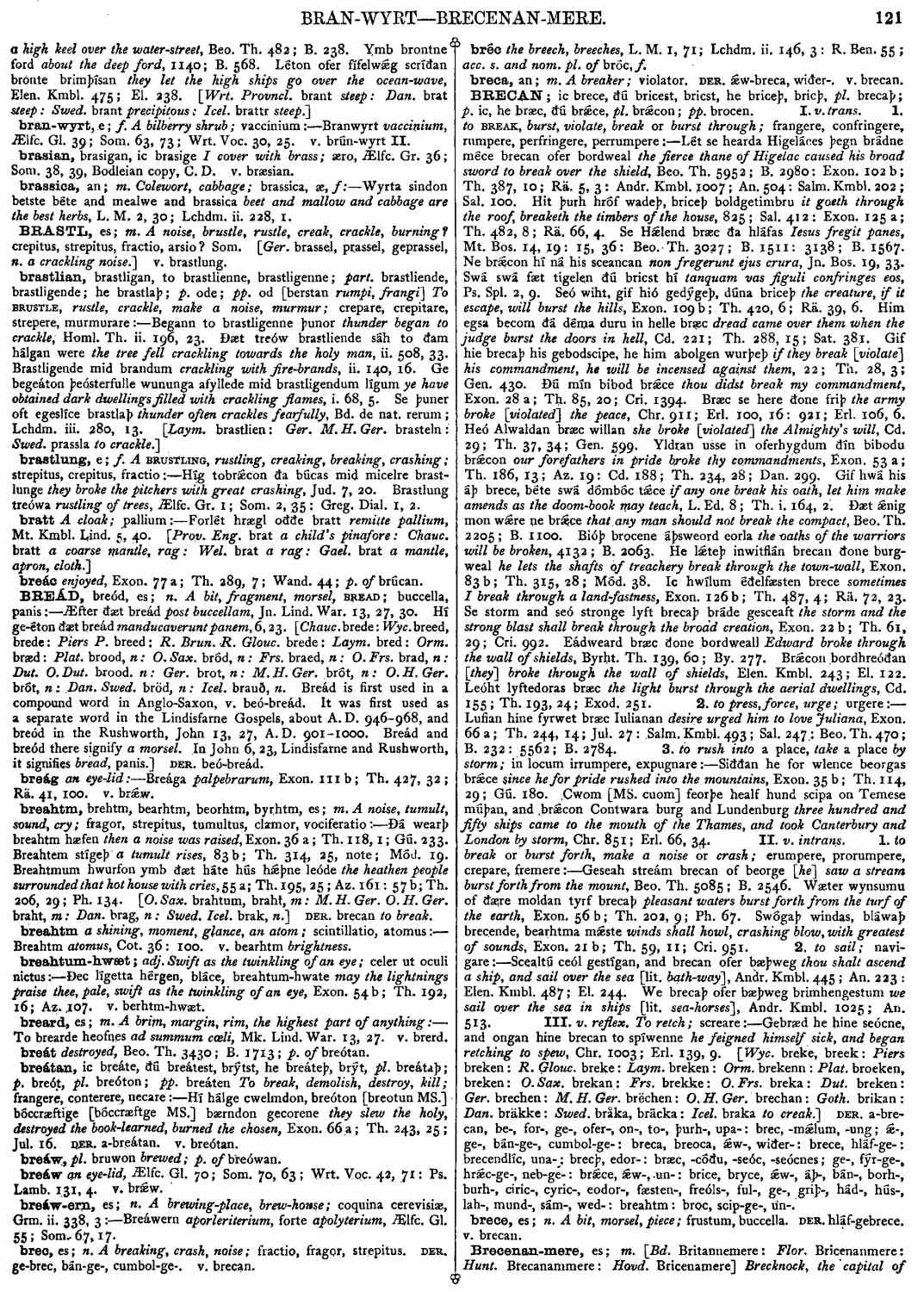
BREÁD
- noun [ neuter ]
Grammar
Wright's OE grammar
§135;
A bit, fragment, morsel, BREAD;
buccella, panis
-
Æfter ðæt breád
post buccellam,
- Jn. Lind. War. 13, 27, 30.
-
Hí ge-éton ðæt breád
manducaverunt panem,
- 6, 23.
Etymology
Chauc. brede:
Wyc. breed, brede:
Piers P. breed:
R. Brun. R. Glouc. brede:
Laym. bred:
Orm. bræd:
Plat. brood, n:
O. Sax. bród, n:
Frs. braed, n:
O. Frs. brad, n:
Dut. O. Dut. brood, n:
Ger. brot, n:
M. H. Ger. brót, n:
O. H. Ger. brót, n:
Dan. Swed. bröd, n:
Icel. brauð, n.
Breád is first used in a compound word in Anglo-Saxon, v. beó-breád. It was first used as a separate word in the - Lindisfarne Gospels
- Rushworth, John 13, 27,
- John 6, 23
Derived forms
Linked entries
v.
breód.
Entry information
Citation
Bosworth, Joseph. “BREÁD.” In An Anglo-Saxon Dictionary Online, edited by Thomas Northcote Toller, Christ Sean, and Ondřej Tichy. Prague: Faculty of Arts, Charles University, 2014. https://bosworthtoller.com/4983.
Checked: 2