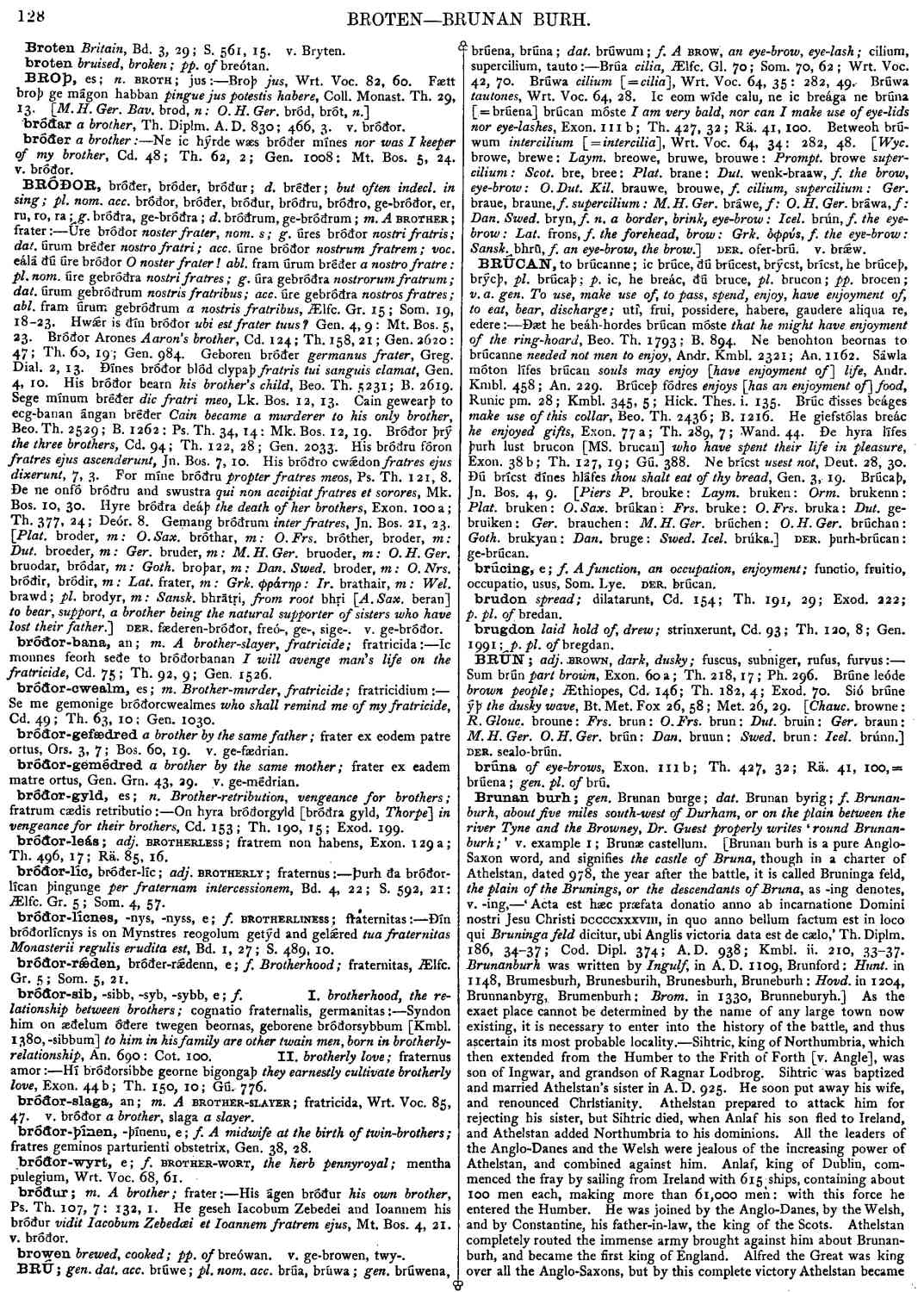
BRÚCAN
- verb [ strong ]
Grammar
Wright's OE grammar
§47;
§131;
§132;
§135;
§167;
§496;
To use, make use of, to pass, spend, enjoy, have enjoyment of, to eat, bear,
discharge; uti, frui, possidere, habere, gaudere aliqua re, edere
-
Ðæt he beáh-hordes brúcan móste
that he might have enjoyment of the ring-hoard,
- Beo. Th. 1793 ;
- B. 894 .
-
Ne benohton beornas to brúcanne
needed not men to enjoy,
- Andr. Kmbl. 2321 ;
- An. 1162 .
-
Sáwla móton lífes brúcan
souls may enjoy [have enjoyment of] life,
- Andr. Kmbl. 458 ;
- An. 229 .
-
Brúceþ fódres
enjoys [has an enjoyment of] food,
- Runic pm. 28 ;
- Kmbl. 345, 5 ;
- Hick. Thes. i. 135 .
-
Brúc ðisses beáges
make use of this collar,
- Beo. Th. 2436 ;
- B. 1216 .
-
He giefstólas breác
he enjoyed gifts,
- Exon. 77 a ;
- Th. 289, 7 ;
- Wand. 44 .
-
Ðe hyra lífes þurh lust brucon [MS. brucan]
who have spent their life in pleasure,
- Exon. 38 b ;
- Th. 127, 19 ;
- Gú. 388 .
-
Ne brícst
usest not,
- Deut. 28, 30 .
-
Ðú brícst ðínes hláfes
thou shalt eat of thy bread,
- Gen. 3, 19 .
-
Brúcaþ,
- Jn. Bos. 4, 9 .
Etymology
Piers P. brouke
:
Laym. bruken
:
Orm. brukenn
:
Plat. bruken
:
O. Sax. brúkan
:
Frs. bruke
:
O. Frs. bruka
:
Dut. ge-bruiken
:
Ger. brauchen
:
M. H. Ger. brúchen
:
O. H. Ger. brúchan
:
Goth. brukyan
:
Dan. bruge
:
Swed. Icel. brúka.
]
Derived forms
Entry information
Citation
Bosworth, Joseph. “BRÚCAN.” In An Anglo-Saxon Dictionary Online, edited by Thomas Northcote Toller, Christ Sean, and Ondřej Tichy. Prague: Faculty of Arts, Charles University, 2014. https://bosworthtoller.com/5244.
Checked: 2