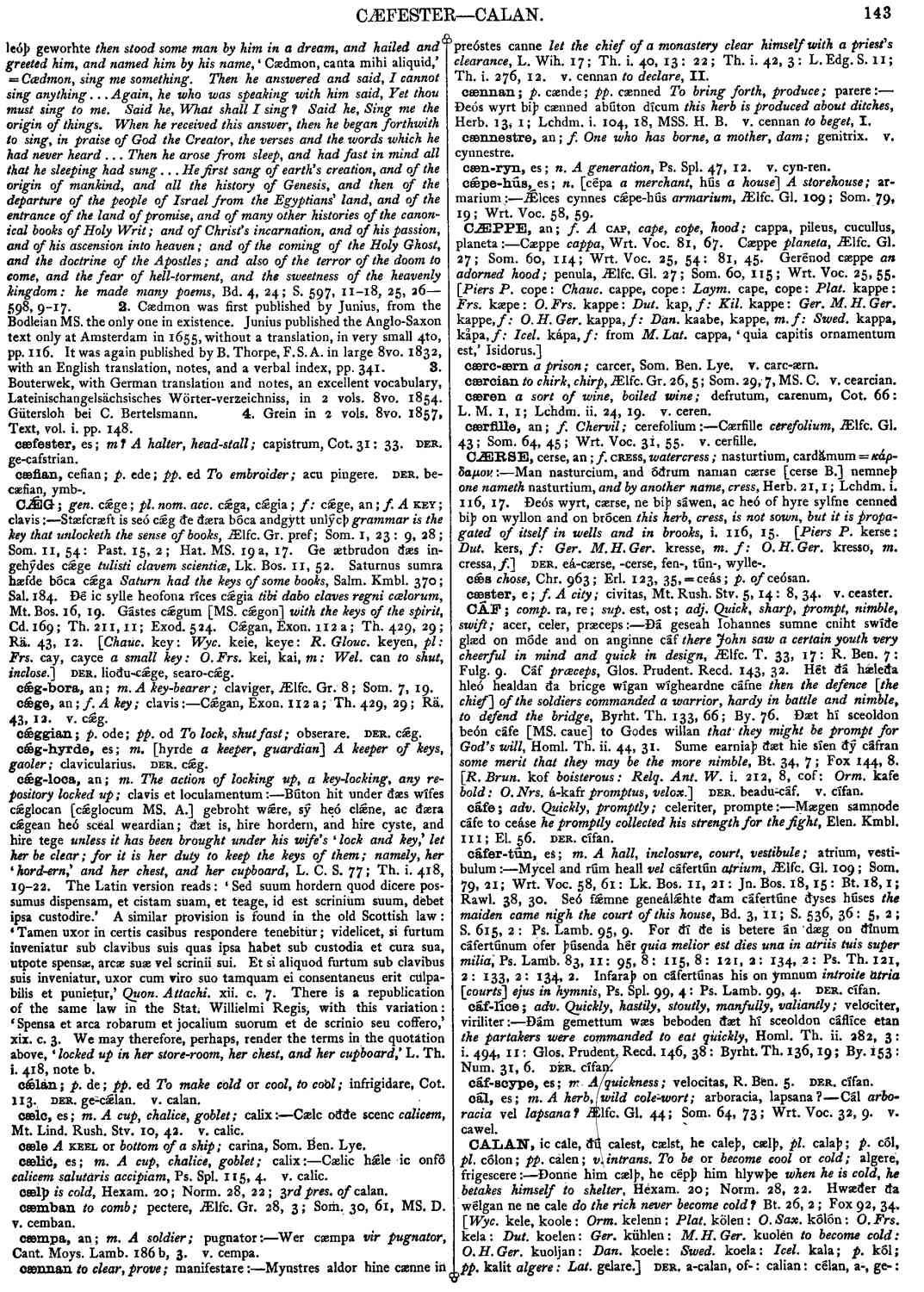
CǼG
- noun [ feminine ]
Grammar
Wright's OE grammar
§275;
§376;
§562;
A KEY ; clavis
-
Stæfcræft is seó cǽg ðe ðæra bóca andgýtt unlýcþ
grammar is the key that unlocketh the sense of books,
- Ælfc. Gr. pref ;
- Som. I. 23: 9, 28 ;
- Som. 11, 54: Past. 15, 2 ;
- Hat. MS. 19a, 17 .
-
Ge ætbrudon ðæs ingehýdes cǽge
tulisti clavem scientiæ,
- Lk. Bos. II, 52 .
-
Saturnus sumra hæfde bóca cǽga
Saturn had the keys of some books,
- Salm. Kmbl. 370 ;
- Sal. 184 .
-
Ðé ic sylle heofona ríces cǽgia
tibi dabo claves regni cælorum,
- Mt. Bos. 16, 19 .
-
Gástes cǽgum [MS. cǽgon]
with the keys of the spirit,
- Cd. 169 ;
- Th. 211, 11 ;
- Exod. 524 .
-
Cǽgan,
- Exon. 112a ;
- Th. 429, 29 ;
- Rä. 43, 12 .
Etymology
Chauc. key
:
Wyc. keie, keye
:
R. Glouc. keyen, pl
:
Frs. cay, cayce a small key
:
O. Frs. kei, kai, m
:
Wel. can to shut, inclose
.]
Derived forms
Linked entries
v.
cǽge.
Entry information
Citation
Bosworth, Joseph. “CǼG.” In An Anglo-Saxon Dictionary Online, edited by Thomas Northcote Toller, Christ Sean, and Ondřej Tichy. Prague: Faculty of Arts, Charles University, 2014. https://bosworthtoller.com/5733.
Checked: 2