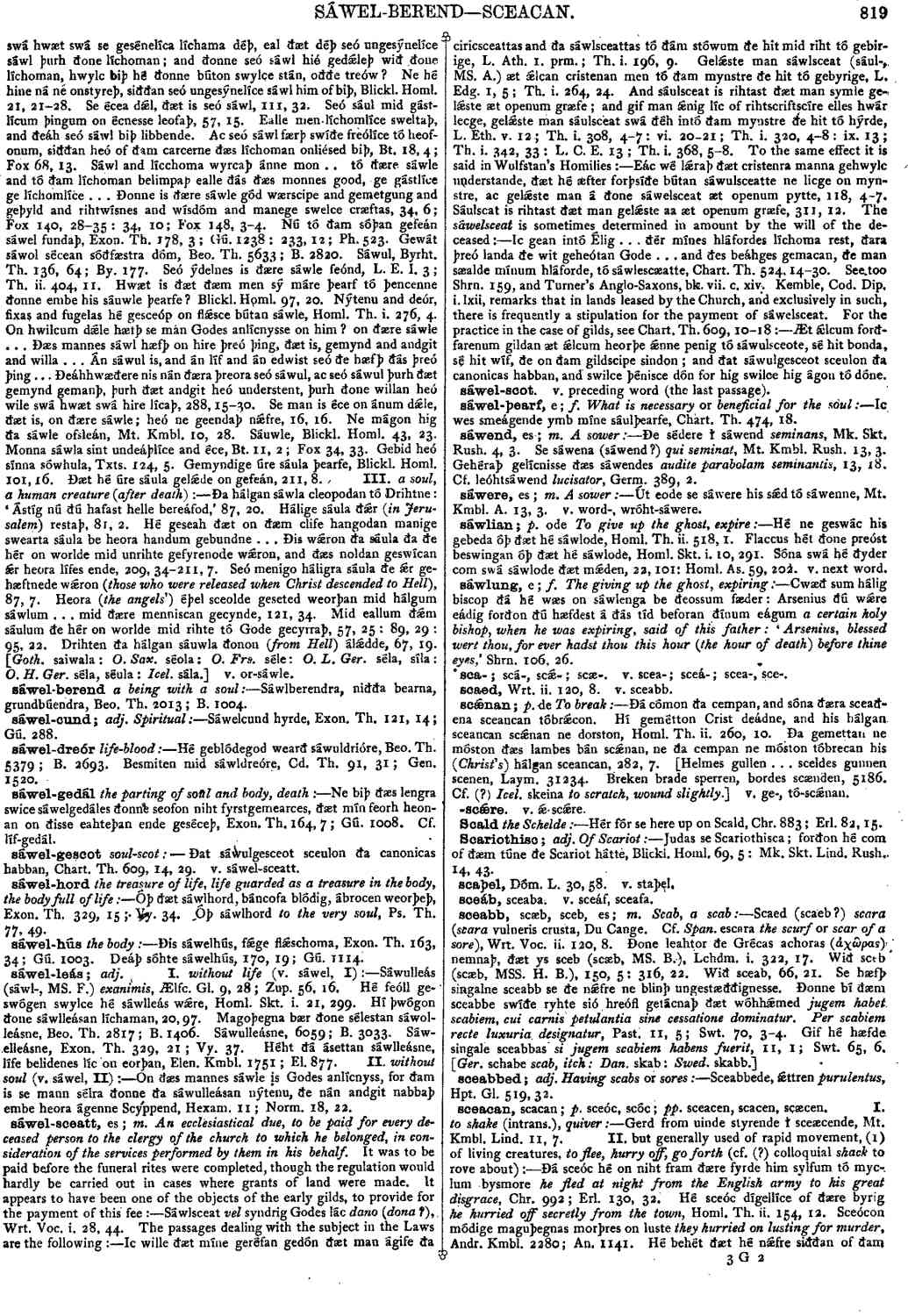
sceacan
- verb [ strong ]
-
Gerd from uinde styrende łsceæcen de,
- Mt. Kmbl. Lind. 11, 7 .
-
Ðá sceóc hé on niht fram ðære fyrde him sylfum tó myclum bysmore
he fled at night from the English army to his great disgrace,
- Chr. 992 ;
- Erl. 130, 32 .
-
Hé sceóc dígellíce of ðære byrig
he hurried off secretly from the town,
- Homl. Th. ii. 154, 12 .
-
Sceócon módige maguþegnas morþres on luste
they hurried on lusting for murder,
- Andr. Kmbl. 2280 ;
- An. 1141 .
-
Hé behét ðæt hé nǽfre siððan of ðam mynstre sceacan nolde
he promised that he would not leave the monastery in a hurry again,
- Homl. Th. ii. 176, 28 .
-
Hwí woldest ðú sceacan bútan mínre gewitnisse
cur ignorante me fugere voluistil?
- Gen. 31, 27 .
-
Deófol ongon on fleám sceacan,
- Exon. Th. 280, 17 ;
- Jul. 630 ;
- Judth. Thw. 25, 34 ;
- Jud. 292 .
-
Hí gewiton in forwyrd sceacan
they hurried to perdition,
- Andr. Kmbl. 3187 ;
- An. 1596 .
-
On gerúm sceacan,
- Exon. Th. 401, 20 ;
- Rä. 21, 14 .
-
On lyft scacan, fleógan ofer foldan,
- Cd. Th. 280, 32 ;
- Sat. 263 ;
- Beo. Th. 3610 ;
- B. 1803 .
- [
Nes þer nan biscop ꝥ forð on his wæi ne scoc, naa
]
-
Hwílum hára scóc forst of feaxe
at times the hoar frost was thrown from my hair,
- Exon. 498, 26 ;
- Rä. 88, 7 .
-
Strǽla storm, strengum gebǽded, scóc ofer scyldweall,
- Beo. Th. 6227 ;
- B. 3118 .
-
Ðonne mín sceaceþ líf of líce
when my life takes flight from the flesh,
- Beo. Th. 5478 ;
- B. 2742 ;
- Exon. Th. 327, 4 ;
- Wíd. 141 .
-
Swǽ giémeleáslíce oft sceacaþ úre geþohtas from ús ðæt wé his furðum ne gefrédaþ
curae vitae ex sensu negligenti quasi nobis non sentientibus procedunt,
- Past. 18, 7 ;
- Swt. 138, 20 .
-
Seó tíd gewát sceacan
time passed on.
- Cd. Th. 9,2 ;
- Gen. 135 .
-
Is nú worn wintra sceacen,
- Elen. Kmbl. 1263 ;
- El. 633 .
-
Ðá wæs dæg sceacen,
- Beo. Th. 4602 ;
- B. 2306, 5448 ;
- B. 2727 .
-
Ðá wæs winter scacen,
- 2277 ;
- B. 1136 .
-
Wæs hira blǽd scacen
their glory had departed,
- 2253 ;
- B. 1124 .
-
Biþ se wén scæcen,
- Exon. Th. 50, 23 ;
- Cri. 805 .
-
Biþ his líf scæcen,
- 329, 25 ;
- Vy. 39 .
-
Biþ týr scecen,
- 447, 27 ;
- Dóm. 45 .
-
Ic sceace (scace, scæce)
concutio,
- Ælfc. Gr. 28, 4 ;
- Zup. 169, 7 .
-
Gúðweard gumena wælhlencan sceóc,
- Cd. Th. 188, 31 ;
- Exod. 176 .
-
Sceacas (scæcas, Rush.) ðæt asca of fótum iúrum
excubite te pulverem de pedibus vestris,
- Mk. Skt. Lind. 6, 11 .
-
Wæs sceacen
vibratur,
- Germ. 401, 47 .
-
Scecen wé plumemus (cf. windan plumemus, 83, 78;
plumarium opus dicitur quod ad modum plumarum texitur, Du Cange)
,- Wrt. Voc. ii. 66, 80.
- Grff. vi.412
Bosworth, Joseph. “sceacan.” In An Anglo-Saxon Dictionary Online, edited by Thomas Northcote Toller, Christ Sean, and Ondřej Tichy. Prague: Faculty of Arts, Charles University, 2014. https://bosworthtoller.com/26487.
Checked: 2