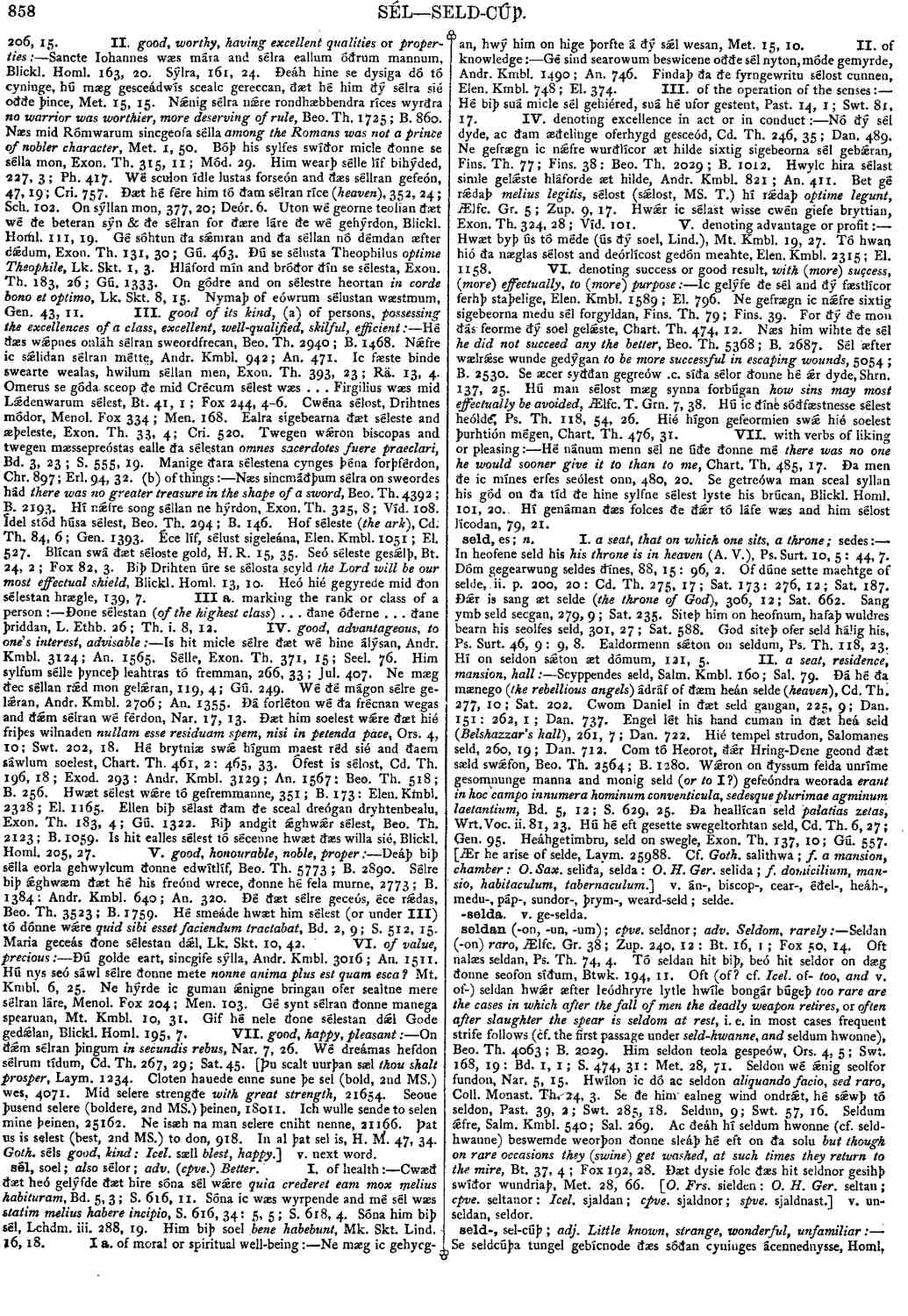
sél
- adverb
-
Cwæð ðæt heó gelýfde ðæt hire sóna sél wǽre
quia crederet eam mox melius habituram,
- Bd. 5, 3 ;
- S. 616, 11 .
-
Sóna ic wæs wyrpende and mé sél wæs
statim melius habere incipio,
- S. 616, 34 :
- 5, 5 ;
- S. 618, 4 .
-
Sóna him biþ sél.
- Lchdm. iii. 288, 19 .
-
Him biþ soel
bene habebunt,
- Mk. Skt. Lind. 16, 18 .
-
Ne mæg ic gehycgan, hwý him on hige þorfte á ðý sǣl wesan
- Met. 15, 10 .
-
Gé sind searowum beswicene oððe sél nyton, móde gemyrde,
- Andr. Kmbl. 1490 ;
- An. 746 .
-
Findaþ ða ðe fyrngewritu sélost cunnen,
- Elen. Kmbl. 748 ;
- El. 374 .
-
Hé biþ suá micle sél gehiéred, suá hé ufor gestent,
- Past. 14, 1 ;
- Swt. 81, 17 .
-
Nó ðý sél dyde, ac ðam æðelinge oferhygd gesceód,
- Cd. Th. 246, 35 ;
- Dan. 489 .
-
Ne gefrægn ic nǽfre wurðlícor æt hilde sixtig sigebeorna sél gebǽran,
- Fins. Th. 77 ;
- Fins. 38 :
- Beo. Th. 2029 ;
- B. 1012 .
-
Hwylc hira sélast simle gelǽste hláforde æt hilde,
- Andr. Kmbl. 821 ;
- An. 411 .
-
Bet gé rǽdaþ melius legitis, sélost (sǽlost,
- MS. T.
optime legunt,
- Ælfc. Gr. 5 ;
- Zup. 9, 17 .
-
Hwǽr ic sélast wisse cwén giefe bryttian,
- Exon. Th. 324, 28 ;
- Víd. 101 .
-
Hwæt byþ ús tó méde (ús ðý soel, Lind.),
- Mt. Kmbl. 19, 27 .
-
Tó hwan hió ða næglas sélost and deórlícost gedón meahte,
- Elen. Kmbl. 2315 ;
- El. 1158 .
-
Ic gelýfe ðe sél and ðý fæstlícor ferhþ staþelige,
- Elen. Kmbl. 1589 ;
- El. 796 .
-
Ne gefrægn ic nǽfre sixtig sigebeorna medu sél forgyldan,
- Fins. Th. 79 ;
- Fins. 39 .
-
For ðý ðe mon ðás feorme ðý soel gelǽste,
- Chart. Th. 474, 12 .
-
Næs him wihte ðe sél
he did not succeed any the better,
- Beo. Th. 5368 ;
- B. 2687 .
-
Sél æfter wælrǽse wunde gedýgan
to be more successful in escaping wounds,
- 5054 ;
- B. 2530 .
-
Se æcer syððan gegreów .c. síða sélor ðonne hé ǽr dyde,
- Shrn. 137, 25 .
-
Hú man sélost mæg synna forbúgan
how sins may most effectually be avoided,
- Ælfc. T. Grn. 7, 38 .
-
Hú ic ðíne; sóðfæstnesse sélest heólde,
- Ps. Th. 118, 54, 26 .
-
Hié hígon gefeormien swǽ hié soelest þurhtión mégen,
- Chart. Th. 476, 31 .
-
Hé nánum menn sél ne úðe ðonne mé
there was no one he would sooner give it to than to me,
- Chart. Th. 485, 17 .
-
Ða men ðe ic mínes erfes seólest onn,
- 480, 20 .
-
Se getreówa man sceal syllan his gód on ða tíd ðe hine sylfne sélest lyste his brúcan,
- Blickl. Homl. 101, 20 .
-
Hí genáman ðæs folces ðe ðǽr tó láfe wæs and him sélost lícodan,
- 79, 21 .
Bosworth, Joseph. “sél.” In An Anglo-Saxon Dictionary Online, edited by Thomas Northcote Toller, Christ Sean, and Ondřej Tichy. Prague: Faculty of Arts, Charles University, 2014. https://bosworthtoller.com/27362.
Checked: 2