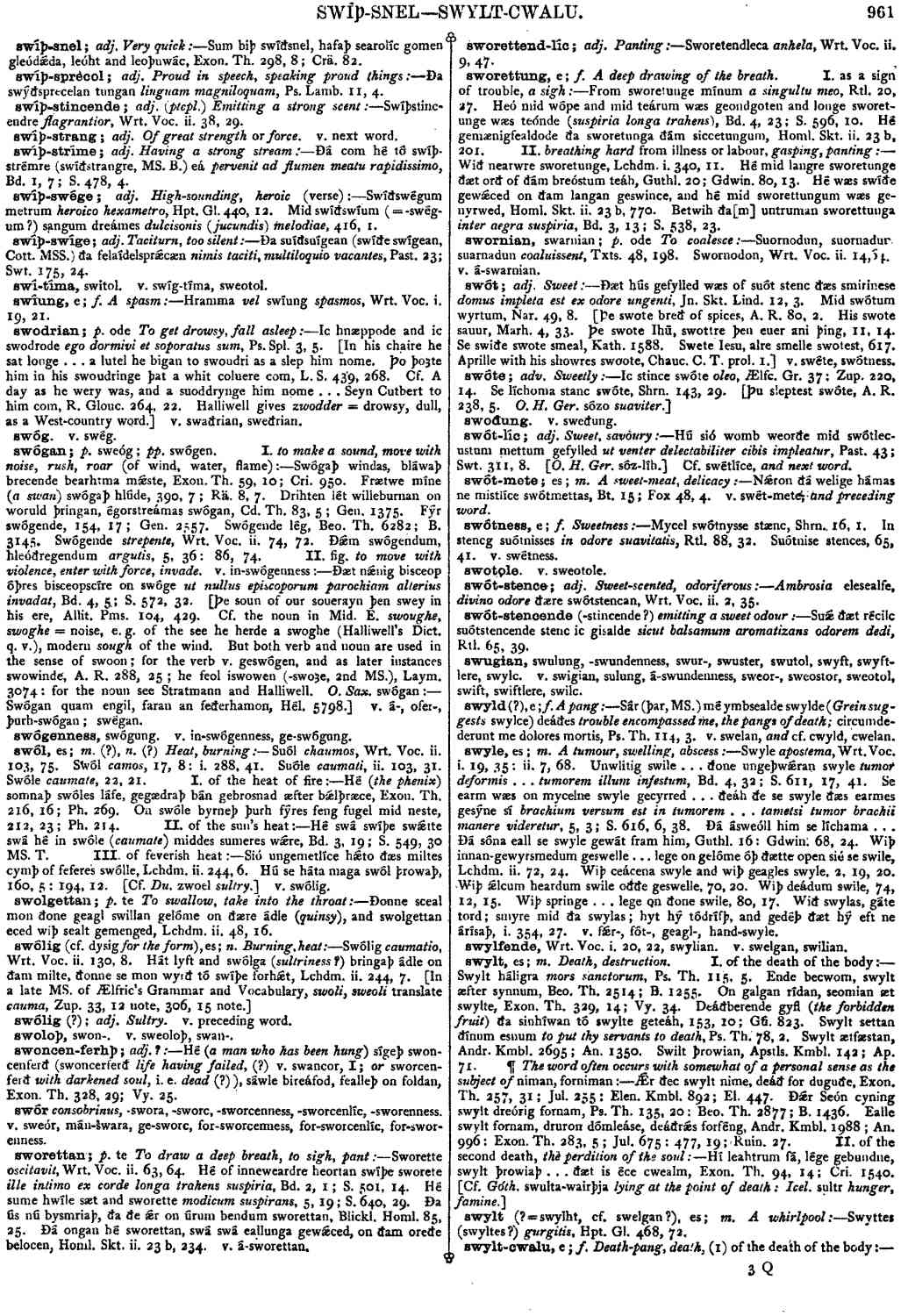
swógan
- verb [ strong ]
Grammar
Wright's OE grammar
§519;
to make a sound, move with noise, rush, roar (of wind, water, flame)
-
Swógaþ windas, bláwaþ brecende bearhtma mǽste,
- Exon. Th. 59, 10 ;
- Cri. 950.
-
Frætwe míne ( a swan ) swógaþ hlúde,
- 390, 7 ;
- Rä. 8, 7.
-
Drihten lét willeburnan on woruld þringan, égorstreámas swógan,
- Cd. Th. 83, 5 ;
- Gen. 1375.
-
Fýr swógende,
- 154, 17 ;
- Gen. 2557.
-
Swógende lég,
- Beo. Th. 6282 ;
- B. 3145.
-
Swógende
strepente,
- Wrt. Voc. ii. 74, 72.
-
Ðǽm swógendum, hleóðregendum
argutis,
- 5, 36: 86, 74.
fig. to move with violence, enter with force, invade. v. in-swógenness
-
Ðæt nǽnig bisceop óþres bisceopscíre on swóge
ut nullus episcoporum parochiam alterius invadat,
- Bd. 4, 5 ;
- S. 572, 32.
Etymology
Þe soun of our souerayn þen swey in his ere, Allit. Pms. 104, 429.
Cf. the noun in
Mid. E. swoughe, swoghe = noise, e. g.of the see he herde a swoghe (Halliwel's Dict. q.
v.), modern sough of the wind.
But both verb and noun are used in the sense of swoon;
for the verb v. geswógen, and as later instances swowinde, A. R.
288, 25
; he feol iswowen (-swoȝe, 2nd MS.), Laym. 3074
: for the noun see Stratmann and
Halliwell.
O. Sax. swógan
Swógan quam engil, faran an feðerhamon, Hél.
5798.
]
Similar entries
Linked entries
v.
ge-swógen in-swógenness on-swógan swégan.
Entry information
Citation
Bosworth, Joseph. “swógan.” In An Anglo-Saxon Dictionary Online, edited by Thomas Northcote Toller, Christ Sean, and Ondřej Tichy. Prague: Faculty of Arts, Charles University, 2014. https://bosworthtoller.com/29889.
Checked: 2