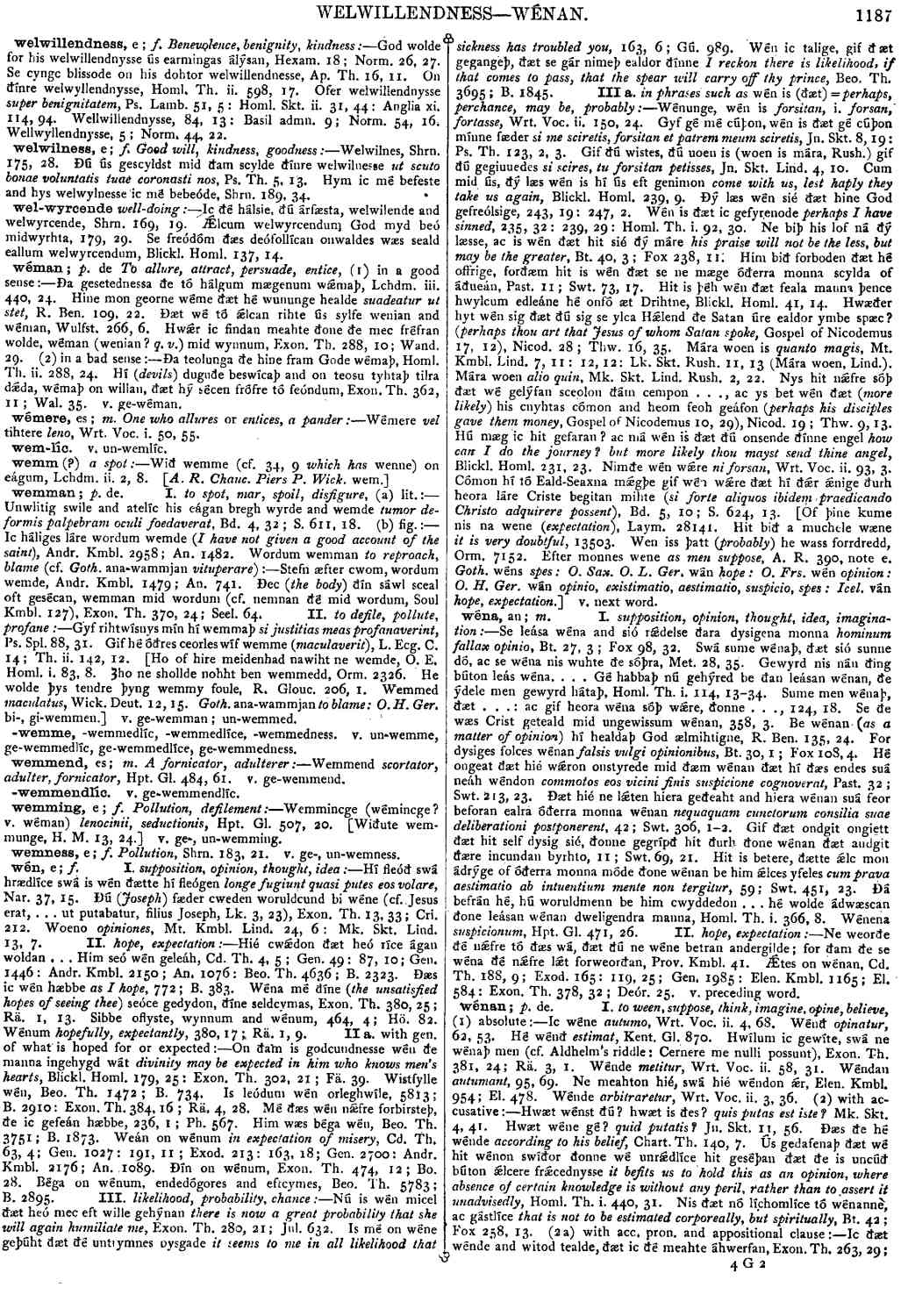
wén
- noun [ feminine ]
-
Hí fleóð swá hrædlíce swá is wén ðætte hí fleógen
longe fugiunt quasi putes eos volare
- Nar. 37, 15.
-
Ðú (Joseph) fæder cweden woruldcund bi wéne (cf. Jesus erat, . . . ut putabatur, filius Joseph,
- Lk. 3, 23
- Exon. Th. 13, 33 ;
- Cri. 212.
-
Woeno
opiniones
- Mt. Kmbl. Lind. 24, 6: Mk. Skt. Lind. 13, 7.
-
Hié cwǽdon ðæt heó ríce ágan woldan . . . Him seó wén geleáh
- Cd. Th. 4, 5; Gen. 49: 87, 10 ;
- Gen. 1446: Andr. Kmbl. 2150 ;
- An. 1076: Beo. Th. 4636 ;
- B. 2323.
-
Ðæs ic wén hæbbe
as I hope
- 772 ;
- B. 383.
-
Wéna mé ðíne (the unsatisfied hopes of seeing thee) seóce gedydon, ðíne seldcymas
- Exon. Th. 380, 25 ;
- Rä. 1, 13 .
-
Sibbe oflyste, wynnum and wénum
- 464, 4 ;
- Hö. 82.
-
Wénum
hopefully, expectantly,
- 380, 17 ;
- Rä. 1, 9.
-
On ðam is godcundnesse wén ðe manna ingehygd wát
divinity may be expected in him who knows men's hearts,
- Blickl. Homl. 179, 25: Exon. Th. 302, 21 ;
- Fä. 39.
-
Wistfylle wén
- Beo. Th. 1472 ;
- B. 734.
-
Is leódum wén orleghwíle
- 5813 ;
- B. 2910: Exon. Th. 384, 16 ;
- Rä. 4, 28.
-
Mé ðæs wén nǽfre forbirsteþ, ðe ic gefeán hæbbe
- 236, 1 ;
- Ph. 567.
-
Him wæs béga wén
- Beo. Th. 3751 ;
- B. 1873.
-
Weán on wénum
in expectation of misery,
- Cd. Th. 63, 4 ;
- Gen. 1027: 191, 11 ;
- Exod. 213: 163, 18 ;
- Gen. 2700: Andr. Kmbl. 2176 ;
- An. 1089 .
-
Ðín on wénum
- Exon. Th. 474, 12 ;
- Bo. 28.
-
Béga on wénum, endedógores and eftcymes
- Beo. Th. 5783 ;
- B. 2895.
-
Nú is wén micel ðæt heó mec eft wille gehýnan
there is now a great probability that she will again humiliate me
- Exon. Th. 280, 21 ;
- Jul. 632.
-
Is mé on wéne geþúht ðæt ðé untrymnes bysgade
it seems to me in all likelihood that sickness has troubled you
- 163, 6 ;
- Gú. 989.
-
Wén ic talige, gif ð æt gegangéþ, ðæt se gár nimeþ ealdor ðínne
I reckon there is likelihood, if that comes to pass, that the spear will carry off thy prince
- Beo. Th. 3695 ;
- B. 1845.
-
Wénunge, wén is
forsitan, i. forsan, fortasse
- Wrt. Voc. ii. 150, 24.
-
Gyf gé mé cúþon, wén is ðæt gé cúþon mínne fæder
si me sciretis, forsitan et patrem meum sciretis
- Jn. Skt. 8, 19: Ps. Th. 123, 2, 3.
-
Gif ðú wistes, ðú uoen is (woen is mára, Rush.) gif ðú gegiuuedes
si scires, tu forsitan petisses
- Jn. Skt. Lind. 4, 10.
-
Cum mid ús, ðý læs wén is hí ús eft genimon
come with us, lest haply they take us again
- Blickl. Homl. 239, 9.
-
Ðý læs wén sié ðæt hine God gefreólsige
- 243, 19: 247, 2.
-
Wén is ðæt ic gefyrenode
perhaps I have sinned
- 235, 32: 239, 29: Homl. Th. i. 92, 30.
-
Ne biþ his lof ná ðý læsse, ac is wén ðæt hit sié ðý máre
his praise will not be the less, but may be the greater
- Bt. 40, 3 ;
- Fox 238, 11.
-
Him bið forboden ðæt hé offrige, forðæm hit is wén ðæt se ne mæge óðerra monna scylda of áðueán
- Past. 11 ;
- Swt. 73, 17.
-
Hit is þéh wén ðæt feala manna þence hwylcum edleáne hé onfó æt Drihtne
- Blickl. Homl. 41, 14.
-
Hwæðer hyt wén sig ðæt ðú sig se ylca Hǽlend ðe Satan úre ealdor ymbe spæc?
(perhaps thou art that Jesus of whom Satan spoke,
- Gospel of Nicodemus 17, 12
- Nicod. 28 ;
- Thw. 16, 35.
-
Mára woen is
quanto magis
- Mt. Kmbl. Lind. 7, 11: 12, 12: Lk. Skt. Rush. 11, 13 (Mára woen, Lind.)
-
Mára woen
alio quin
- Mk. Skt. Lind. Rush. 2, 22.
-
Nys hit nǽfre sóþ ðæt wé gelýfan sceolon ðám cempon . . ., ac ys bet wén ðæt (more likely) his cnyhtas cómon and heom feoh geáfon (perhaps his disciples gave them money, Gospel of Nicodemus 10, 29)
- Nicod. 19 ;
- Thw. 9, 13.
-
Hú mæg ic hit gefaran? ac má wén is ðæt ðú onsende ðínne engel
how can I do the journey? but more likely thou mayst send thine angel
- Blickl. Homl. 231, 23.
-
Nimðe wén wǽre
ni forsan,
- Wrt. Voc. ii. 93, 3.
-
Cómon hí tó Eald-Seaxna mǽgþe gif wén wǽre ðæt hí ðǽr ǽnige ðurh heora láre Criste begitan mihte
(si forte aliquos ibidem praedicando Christo adquirere possent)
- Bd. 5, 10 ;
- S. 624, 13.
- Laym. 28141.
- 13503.
- Orm. 7152.
- A. R. 390, note e.
Bosworth, Joseph. “wén.” In An Anglo-Saxon Dictionary Online, edited by Thomas Northcote Toller, Christ Sean, and Ondřej Tichy. Prague: Faculty of Arts, Charles University, 2014. https://bosworthtoller.com/35062.
Checked: 2