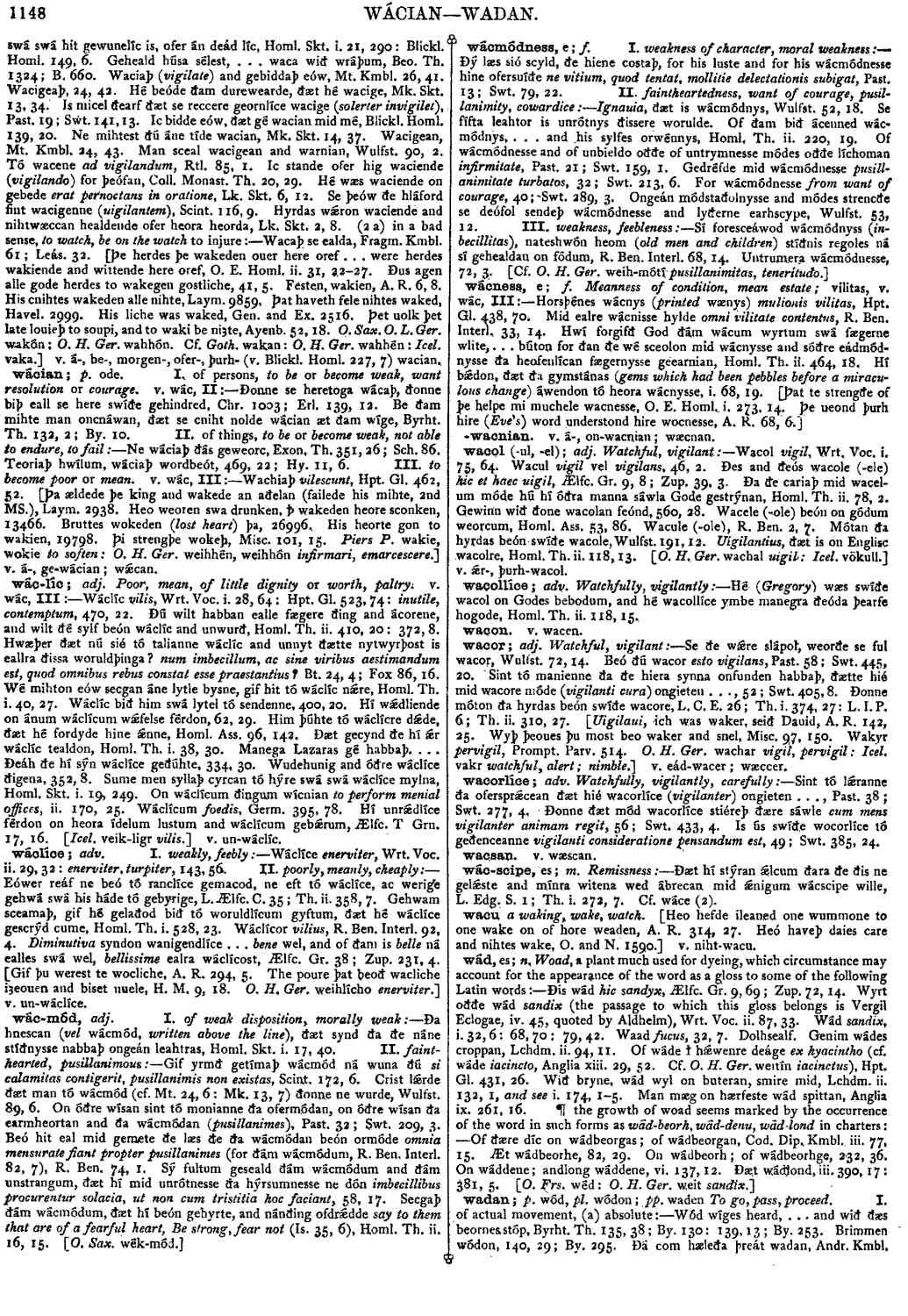
wácian
- verb [ weak ]
Grammar
Wright's OE grammar
§536;
of persons, to be or become weak, want resolution or courage.
Similar entries
-
Ðonne se heretoga wácaþ, ðonne biþ eall se here swíðe gehindred,
- Chr. 1003 ;
- Erl, 139, 12.
-
Be ðam mihte man oncnáwan, ðæt se cniht nolde wácian æt ðam wíge,
- Byrht. Th. 132, 2 ;
- By. 10.
of things, to be or become weak, not able to endure, to fail
-
Ne wáciaþ ðás geweorc,
- Exon, Th. 351, 26 ;
- Sch. 86.
-
Teoriaþ hwílum, wáciaþ wordbeót,
- 469, 22 ;
- Hy. 11, 6.
to become poor or mean.
Similar entries
-
Wachiaþ
vilescunt,
- Hpt. Gl. 462, 52.
Etymology
- 2nd MS.
- Laym. 2938.
- 13466.
- 26996
- 19798
- Misc. 101, 15.
- Piers P.
O. H. Ger. weihhén, weihhón infirmari, emarcescere
.]
Linked entries
v.
ge-wácian.
Entry information
Citation
Bosworth, Joseph. “wácian.” In An Anglo-Saxon Dictionary Online, edited by Thomas Northcote Toller, Christ Sean, and Ondřej Tichy. Prague: Faculty of Arts, Charles University, 2014. https://bosworthtoller.com/34187.
Checked: 2