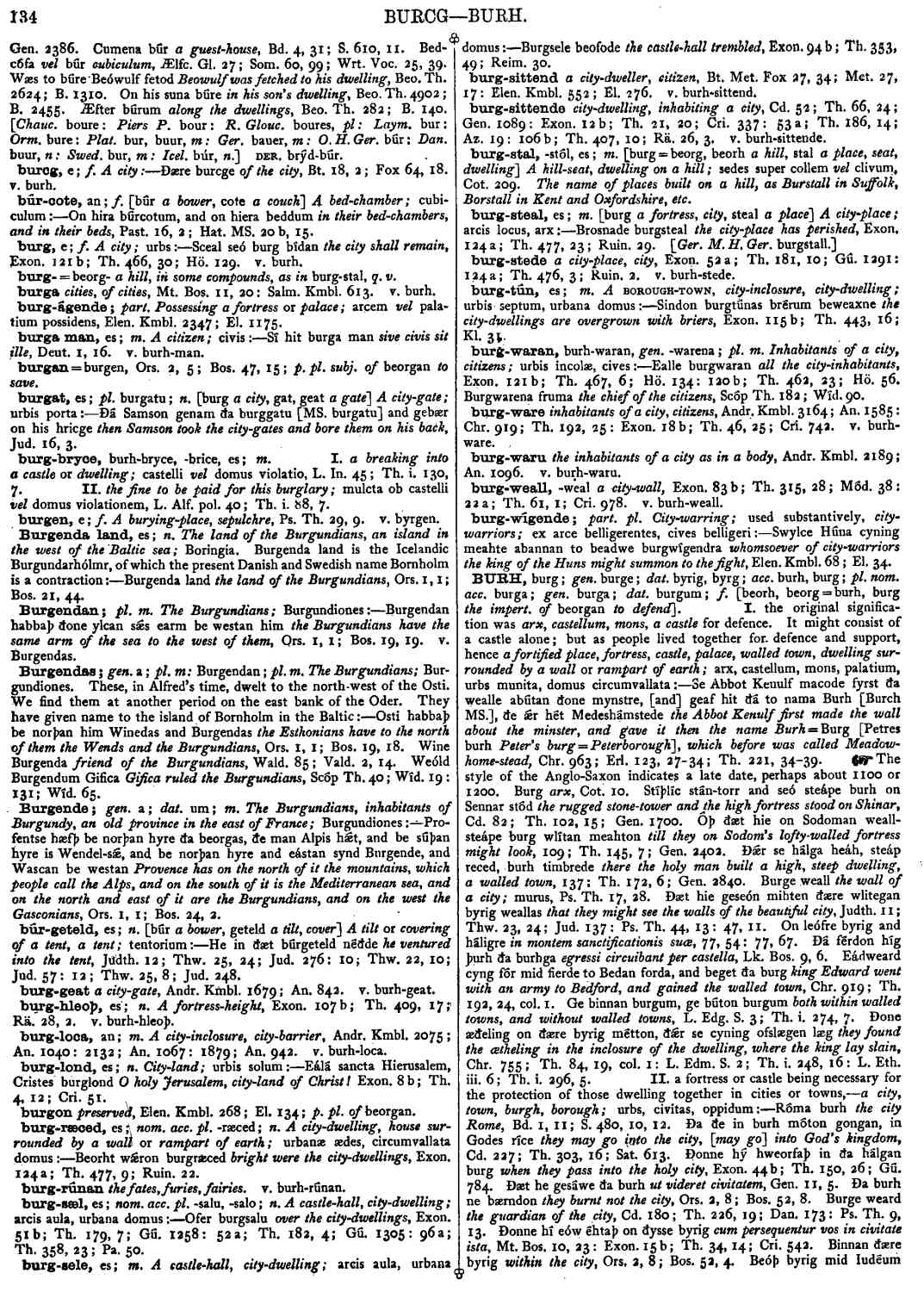
BURH
- noun [ feminine ]
-
Se Abbot Kenulf macode fyrst ða wealle abútan ðone mynstre, [and] geaf hit ðá to nama Burh [Burch MS.], ðe ǽr hét Medeshámstede
the Abbot Kenulf first made the wall about the minster, and gave it then the name Burh =
Similar entriesBurg [Petres burhPeter's burg = Peterborough] , which before was called Meadow-home-stead,- Chr. 963 ;
- Erl. 123, 27-34 ;
- Th. 221, 34-39. .
-
Burg
arx,
- Cot. 10.
-
Stíþlíc stán-torr and seó steápe burh on Sennar stód
the rugged stone-tower and the high fortress stood on Shinar,
- Cd. 82 ;
- Th. 102, 15 ;
- Gen. 1700.
-
Óþ ðæt hie on Sodoman weall-steápe burg wlítan meahton
till they on Sodom's lofty-walled fortress might look,
- 109 ;
- Th. 145, 7 ;
- Gen. 2402 .
-
Ðǽr se hálga heáh, steáp reced, burh timbrede
there the holy man built a high, steep dwelling, a walled town,
- 137 ;
- Th. 172, 6 ;
- Gen. 2840 .
-
Burge weall
the wall of a city;
murus
,- Ps. Th. 17, 28.
-
Ðæt hie geseón mihten ðære wlitegan byrig weallas
that they might see the walls of the beautiful city,
- Judth. 11 ;
- Thw. 23, 24 ;
- Jud. 137 :
- Ps. Th. 44, 13: 47, 11 .
-
On leófre byrig and háligre
in montem sanctificationis suæ,
- 77, 54: 77, 67 .
-
Ðá férdon híg þurh ða burhga
egressi circuibant per castella.
- Lk. Bos. 9, 6 .
-
Eádweard cyng fór mid fierde to Bedan forda, and beget ða burg
king Edward went with an army to Bedford, and gained the walled town,
- Chr.919 ;
- Th. 192, 24, col. l .
-
Ge binnan burgum, ge búton burgum
both within walled towns, and without walled towns,
- L. Edg. S. 3 ;
- Th. i. 274, 7 .
-
Ðone æðeling on ðære byrig métton, ðǽr se cyning ofslægen læg
they found the ætheling in the inclosure of the dwelling, where the king lay slain,
- Chr. 755 ;
- Th. 84, 19, col. 1 :
- L. Edm. S. 2 ;
- Th. i. 248, 16 :
- L. Eth. iii. 6 ;
- Th. i. 296, 5 .
-
Róma burh
the city Rome,
- Bd. 1. 11 ;
- S. 480, 10, 12 .
-
Ða ðe in burh móton gongan, in Godes ríce
they may go into the city, [may go] into God's kingdom,
- Cd. 227 ;
- Th. 303, 16 ;
- Sat. 613 .
-
Ðonne hý hweorfaþ in ða hálgan burg
when they pass into the holy city,
- Exon. 44b ;
- Th. 150, 26 ;
- Gú. 784 .
-
Ðæt he gesáwe ða burh
ut videret civitatem,
- Gen. 11, 5 .
-
Ða burh ne bærndon
they burnt not the city,
- Ors. 2, 8 ;
- Bos. 52, 8 .
-
Burge weard
the guardian of the city,
- Cd. 180 ;
- Th. 226, 19 ;
- Dan. 173 :
- Ps. Th. 9, 13 .
-
Ðonne hí eów éhtaþ on ðysse byrig
cum persequentur vos in civitate ista,
- Mt. Bos. 10, 23 :
- Exon. 15b ;
- Th. 34, 14 ;
- Cri. 542.
-
Binnan ðære byrig
within the city,
- Ors. 2, 8 ;
- Bos. 52, 4.
-
Beóþ byrig mid Iudéum getimbrade
ædificabuntur civitates Judæ,
- Ps. Th. 68, 36.
-
Byrig fægriaþ
towns appear fair,
- Exon. 82a ;
- Th. 308, 32 ;
- Seef. 48.
-
Ðá ongan he hyspan ða burga
tunc cæpit exprobrare civitatibus,
- Mt. Bos. 11, 20.
-
On burgum
in the towns,
- Beo. Th. 105 ;
- B. 53.
Bosworth, Joseph. “BURH.” In An Anglo-Saxon Dictionary Online, edited by Thomas Northcote Toller, Christ Sean, and Ondřej Tichy. Prague: Faculty of Arts, Charles University, 2014. https://bosworthtoller.com/5434.
Checked: 2